Jump to section
How to Start a Tax Preparation Business: 2026 Checklist
The exact steps to start a tax preparation business in 2026, from your PTIN and EFIN to state rules, pricing, software and your first clients.
·7 min read·By Abby Melby
Key Takeaways
- Every paid preparer needs a PTIN. The 2026 fee is $18.75 and it renews every year by December 31.
- Apply for your EFIN early. IRS approval can take up to 45 days, and non credentialed owners need fingerprints.
- California, Connecticut, Maryland, New York and Oregon have their own registration or licensing rules.
- Decide your client intake process before your first season, not during it. It is the part that eats the most time.
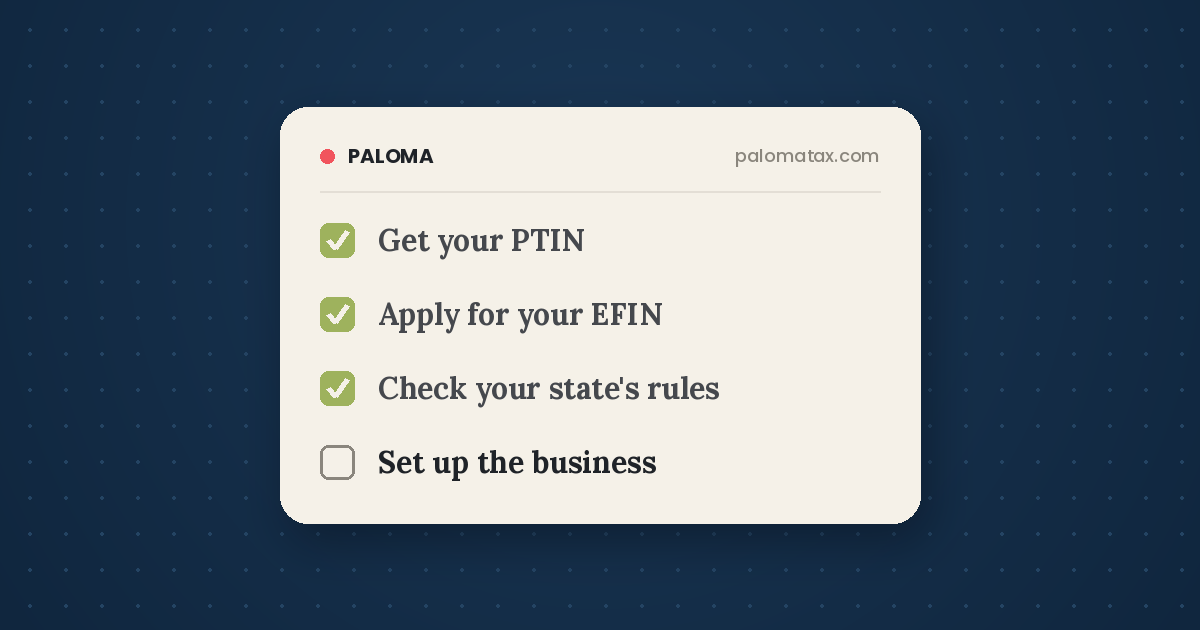
To start a tax preparation business, get an IRS PTIN, apply for an EFIN so you can e-file, check whether your state requires its own license, set up your business entity and insurance, choose your software, and decide how clients will send you their documents. The EFIN can take up to 45 days, so start there first.
Step 1: Get your PTIN
A Preparer Tax Identification Number (PTIN) is required for anyone who prepares federal returns for pay. You apply online through the IRS.
The fee for 2026 is $18.75, and PTINs expire every December 31, so you renew each fall (IRS PTIN FAQ). If you plan to work January through April, renew in November or early December so you are not scrambling on day one of the season.
Step 2: Apply for your EFIN (start this now)
Your Electronic Filing Identification Number (EFIN) is what lets you e-file returns for clients. Without it, you can prepare returns but not file them electronically, which most clients now expect.
Here is how the process works, straight from the IRS (become an authorized e-file provider):
- Create an IRS e-Services account. Every principal and responsible official on the application needs one first.
- Fill out the e-file application. Most preparers choose Electronic Return Originator (ERO).
- If you are not a CPA, enrolled agent or attorney, you get fingerprinted through the IRS Livescan vendor. You schedule that yourself from the application summary page.
- The IRS runs a suitability check, which can include credit, tax compliance and criminal background checks.
- You get an acceptance letter with your EFIN.
There is no fee for an EFIN (IRS EFIN FAQ), but approval can take up to 45 days. If you want to file returns in late January, apply by early December at the latest.
New firm? Starter Pack, $65/mo
Full platform access for firms in their first two years
Step 3: Check your state's rules
Most states let you prepare returns with just a PTIN. A handful do not. These five have their own requirements (Surgent Income Tax School):
| State | What you need |
|---|---|
| California | Annual CTEC registration, 60 hour qualifying course, $5,000 bond, PTIN, background check |
| Connecticut | State registration with a $100 application fee |
| Maryland | State registration, PTIN and a state exam (CPAs, EAs and attorneys are exempt from the exam) |
| New York | Annual registration if you are paid to prepare New York returns |
| Oregon | State license, 80 hour basic tax course, state exam and PTIN |
Rules change, so confirm on your state tax agency's site before you file your first return.
Step 4: Set up the business
You can start as a sole proprietor, but many new tax pros form an LLC to separate business and personal liability. Talk to an attorney or use your state's business filing portal, then get an EIN from the IRS (it is free and instant online).
While you are at it, set up:
- A business bank account. Keep client payments out of your personal account from day one.
- Errors and omissions (E&O) insurance. One wrong number on a return can cost a client real money. E&O covers you if they come back on you.
- A written information security plan (WISP). The IRS says the law requires tax practices to have one (IRS Publication 5708), and you will hold Social Security numbers, bank details and income records.
Step 5: Decide what you offer and how you price it
Pick a lane before you pick software. Your services decide which tools you need.
Most new firms start with one of these:
- Individual returns (1040). The biggest market, very seasonal.
- Small business returns. Schedule C, partnerships and S corps. Higher fees, more year round work.
- Bookkeeping plus tax. Monthly recurring revenue that smooths out the off season.
For pricing, choose between per form (a base fee plus a fee for each schedule) and flat packages (simple, standard and complex). Flat packages are easier for clients to understand and easier for you to quote. Whatever you choose, write it down and put it on your website so you stop pricing every client from scratch.
Book a demo
See client intake and doc collection on your own workflow
Step 6: Choose your software stack
You need three kinds of tools. Plenty of new firms only think about the first one.
| Tool | What it does | When you need it |
|---|---|---|
| Professional tax software | Prepares and e-files the return | Before your first return |
| Client intake and document collection | Gets organizers, questionnaires and documents from clients, and tracks what is missing | Before your first client |
| Practice management (optional) | Billing, tasks, team workflow | Once you have staff |
Tax software is the obvious one. The second row, client intake software, is the one that decides whether your first season feels calm or chaotic. Chasing a client for a missing 1099 over text, email and voicemail is where new firm owners lose most of their nights in March.
Step 7: Plan your client intake process
Here is a hypothetical first season. You sign 60 clients. Each one needs an engagement letter, an organizer or questionnaire, and somewhere between five and twenty documents. If each client takes three rounds of back and forth to send everything, that is 180 email threads before you prepare a single return.
A clean intake process fixes this. Use this checklist before your first client signs:
- A new client intake form (contact info, filing status, dependents, prior preparer)
- An engagement letter clients can sign online
- A tax organizer or questionnaire for returning items (income, deductions, life changes)
- One secure place for clients to upload documents, not email
- Automatic reminders for missing documents
- A way to deliver the finished return and get the e-file authorization signed
This is the problem we built Paloma for. It sends custom intake questionnaires, collects and reads client documents, and reminds clients about what is still missing so you do not have to.
Step 8: Find your first clients
Your first clients usually come from people who already know you. Start there.
- Tell your network directly. A personal message beats a social post.
- Ask every client for one referral when you deliver their return.
- Set up a free Google Business Profile so you show up for "tax preparer near me."
- Partner with local bookkeepers, real estate agents and small business groups who get asked "do you know a good tax person?"
- Open your booking calendar before January so new clients can grab a spot.
Your 90 day launch timeline
| When | What to do |
|---|---|
| 90 days out | Form your LLC, get your EIN, apply for PTIN and EFIN |
| 60 days out | Check state rules, buy E&O insurance, write your WISP |
| 45 days out | Pick tax software and your client intake tool, set your prices |
| 30 days out | Build your intake form, engagement letter and organizer; open your booking calendar |
| 2 weeks out | Send returning client organizers; do a test run of your whole process with one friendly client |
Frequently Asked Questions
How much does it cost to start a tax preparation business?
The required IRS pieces are cheap: the PTIN is $18.75 for 2026 and the EFIN is free. Your real costs are professional tax software, E&O insurance, your business entity filing and any state registration, which varies by state.
Do I need a license to start a tax preparation business?
Not in most states. You need an IRS PTIN everywhere, and California, Connecticut, Maryland, New York and Oregon have their own registration or licensing rules.
How long does it take to get an EFIN?
The IRS says approval can take up to 45 days from when you submit your application, so apply well before tax season.
Can I start a tax preparation business from home?
Yes. Many new firms start from home with a dedicated workspace, secure document storage and a client portal so clients never need to come by in person.
Do I need to be a CPA or enrolled agent to prepare taxes?
No. Anyone with a PTIN can prepare returns for pay, as long as they meet their state's rules. Credentials like EA or CPA let you represent clients before the IRS and can help you charge more.
What software do I need to start?
At minimum, professional tax software to prepare and e-file returns, plus a secure way to collect client documents. Most firms add client intake and reminder tools before their first full season.
Start your first season organized
If you are launching a firm in 2025 or 2026, the Paloma Starter Pack gives new firms full access to client intake, document collection and reminders for $65 a month. Book a quick demo and we will help you set up your intake process before your first client walks in.
Try Paloma
Related Articles
Engagement Letter for Tax Preparers: Clauses and Template
The clauses every tax prep engagement letter needs, the mistakes that cause scope creep and fee fights, and a plain language template you can adapt.
Read more →
Do I Need a CPA for My LLC? How to Decide for Your Setup
No law says your LLC needs a CPA. Here's how your LLC is taxed, when filing yourself works, and the moments when paying for help makes sense.
Read more →
Tax Document OCR: How It Works and Where It Breaks
How tax document OCR reads W-2s, 1099s and K-1s, where it gets values wrong, and how small tax firms can review the output fast.
Read more →
How Much Does It Cost to Have Business Taxes Done?
What business tax returns really cost once you add the owner's return, states and books, plus how to get a fixed quote before tax season.
Read more →Ready to stop chasing client documents?
Paloma collects, sorts and reads your clients’ tax documents so your team can start prep sooner.
Book a demo