Jump to section
Engagement Letter for Tax Preparers: Clauses and Template
The clauses every tax prep engagement letter needs, the mistakes that cause scope creep and fee fights, and a plain language template you can adapt.
·8 min read·By Abby Melby
Key Takeaways
- Name the exact forms and tax year. "All income tax returns" invites scope creep.
- Put the client's responsibilities in writing: complete information, a document deadline, and keeping records.
- Spell out fees, what costs extra, and how IRS letters get handled.
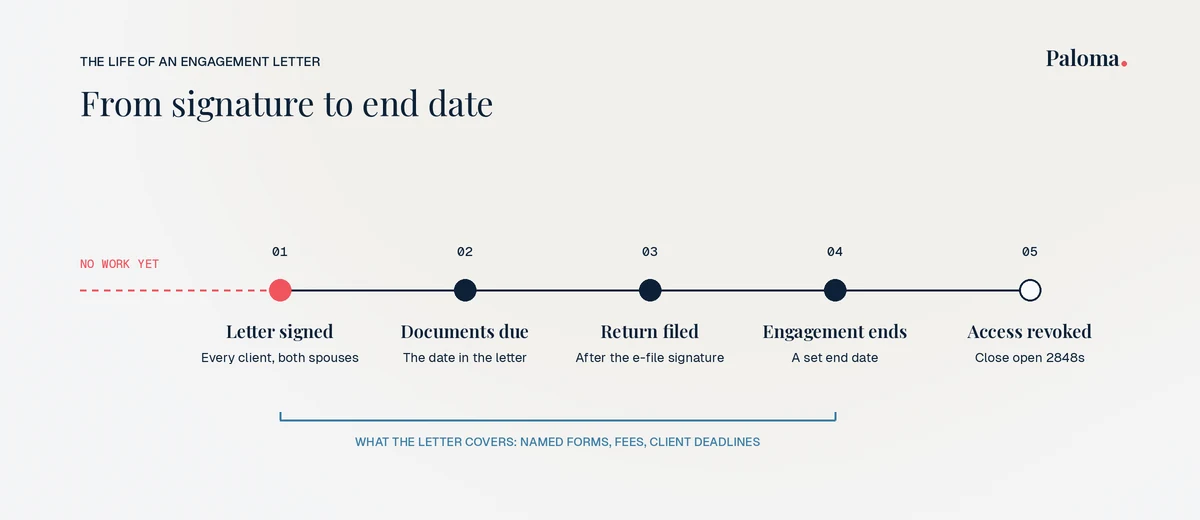
- Give the engagement an end date, and don't start work until the letter is signed.
- Have your own attorney and your liability insurer review your template once a year.
An engagement letter for tax preparers is a short signed agreement that says who the client is, which returns you'll prepare for which year, what the client has to provide and by when, what it costs, and when the engagement ends. Get it signed before you start any work, every year.
Why tax preparers need one every year
Most fee fights and "I thought you were doing that" moments come down to a missing or vague engagement letter. As Tom O'Saben, EA, puts it for the University of Illinois Tax School, "many complaints stem from misunderstandings" about fees, and he asks the question that should stick with every new firm: "if an engagement letter isn't signed, do you have an engagement?" (U of I Tax School).
The Tax Adviser says the same thing from the risk side. A signed letter "provides clarity and prevents scope creep," and firms should tell clients that "work cannot commence until the engagement letter has been signed" (The Tax Adviser).
If you're just getting your practice set up, the engagement letter belongs right alongside your PTIN, EFIN and intake process. We walk through the rest of that setup in our 2026 checklist for starting a tax preparation business.
What to include in a tax preparation engagement letter
Here's what the sources I read agree on, in the order I'd put it in the letter.
1. Who the client is
Say exactly who you represent: an individual, a married couple filing jointly, a business, or a trust. For clients with more than one activity, list each one. A couple going through a divorce or business partners who might disagree later are a reason for a separate letter or a conflict waiver.
2. The tax year and the exact forms
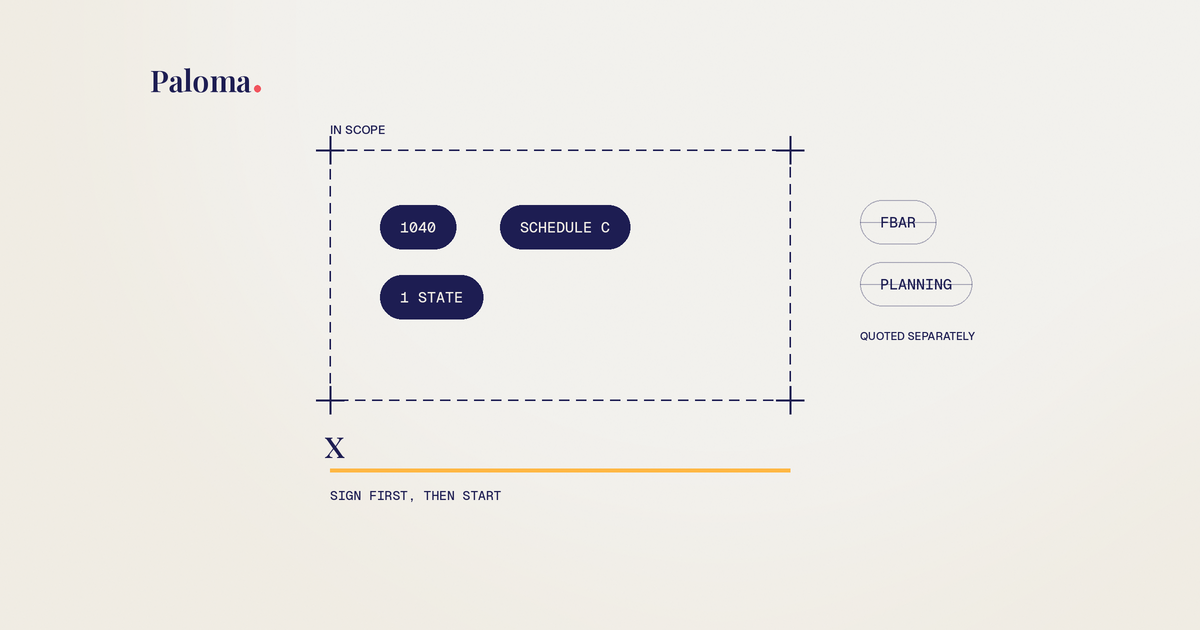
Name the tax year and every return you'll prepare. "2026 Form 1040, Schedule C and one state return" is clear. "All income tax returns" is not. The Tax Adviser recommends naming forms individually and listing what's excluded, like the FBAR, instead of using broad phrases.
3. What's not included
List common extras and say they're quoted separately: bookkeeping or cleanup, tax planning or advisory work, amended returns, prior year returns, additional states, and responding to IRS or state notices. Intuit's guidance for tax pros suggests "stating additional work will be discussed with the client prior to starting work," including the price and timing (Intuit Tax Pro Center).
4. Client responsibilities
This is the section that protects you most. The client agrees that:
- The information they give you is complete and accurate
- You'll rely on it and won't audit or verify it
- They'll send everything by a specific date so you can file on time
- They'll keep the records that support the return in case of an exam
The letter should also say what happens when documents arrive late: an extension, a later delivery date, or added fees.
5. Fees and payment
Say how you price (flat fee, minimum plus complexity, or hourly), when payment is due, and how clients pay. If records come in incomplete and need extra work, say that costs more. TaxSlayer Pro recommends the letter cover "the work that you will do for your client and the fees that you charge," including what happens when records are incomplete (TaxSlayer Pro).
6. Extensions and deadlines
Explain that an extension gives more time to file, not more time to pay. The Tax Adviser says clients should understand "the taxes must be paid by the due date," and that you should document how you estimated the payment on any extension.
7. IRS letters and representation
Say whether answering IRS or state letters is included or billed separately. If you'll need access to the client's IRS records, mention the authorization forms. Form 8821 only lets you see tax information, while Form 2848 lets an authorized practitioner represent the client. The Tax Adviser notes that "Form 8821 automatically expires after seven years, while a Form 2848 must be revoked," so keep a list of open authorizations and revoke them when the engagement ends.
8. Electronic filing, signatures and data
Say that you'll e-file and that the client signs the e-file authorization before you transmit. Cover how documents are exchanged (a secure portal, not email). If you'll ever use or share the client's tax information for anything beyond preparing the return, the IRS says "a taxpayer must provide written consent before a tax return preparer discloses the taxpayer's tax return information" (IRS Section 7216 FAQs). Handle that consent as its own signed form that meets the IRS requirements.
9. When the engagement ends
Give the engagement an end date, for example when the return is filed or on a set date. The Tax Adviser points out that the end date matters for your statute of limitations, so don't leave it open ended.
10. Signatures
Get a signature from every client, including both spouses on a joint return. E-signatures make this fast, and you can check the letter is signed before you open the organizer.
New firm? Starter Pack, $65/mo
Full platform access for firms in their first two years
Engagement letter template for tax preparers
Use this as a starting point, not a final legal document. Every source I read, including the U of I Tax School, says sample letters "can never replace a meeting with an attorney," so have yours reviewed for your state and your insurance.
Common mistakes to avoid
- Starting before it's signed. It's tempting when a client drops off documents in March. Don't.
- Copying last year's letter without reading it. TaxSlayer Pro and the U of I Tax School both recommend reviewing it every year as rules and your services change.
- One letter for everything. Tax planning and advisory work usually deserve their own letter with their own terms, according to The Tax Adviser.
- Leaving the fee vague. "Fees vary" is how fee disputes start. Give the number or the method.
- Burying the client deadline. Put the document due date where clients will see it, not in the last paragraph.
- Forgetting the second spouse. Joint returns need both signatures.
How to send and track engagement letters
The old way was print, sign, scan and email, then hunt for which clients never sent it back. A simpler setup is to make the engagement letter the first step of onboarding: the client signs it online, and only then gets the organizer and document checklist. If you use Paloma, here's how engagement letters fit into that onboarding flow. Pair it with a good tax client intake form so you collect everything you need right after the letter is signed.
Book a demo
See client intake and doc collection on your own workflow
Frequently Asked Questions
Is an engagement letter required for tax preparers?
There's no single IRS rule that requires one for every return, but practitioner guidance from The Tax Adviser, the U of I Tax School and others treats it as essential, and many liability insurers expect one. Ask your insurer what they require.
Do I need a new engagement letter every year?
Yes. Each letter should cover a specific tax year, and reviewing it annually lets you update fees, services and wording as tax rules change.
Can clients sign an engagement letter electronically?
Yes, e-signatures are common for engagement letters and speed up onboarding. Check with your attorney that your process meets your state's rules.
What's the difference between an engagement letter and Form 8821 or 2848?
The engagement letter is your agreement with the client. Form 8821 lets you see the client's IRS information, and Form 2848 lets an authorized practitioner represent them. They're separate documents.
Should tax planning go in the same engagement letter?
Usually not. The Tax Adviser recommends a separate engagement letter for planning and advisory work, with its own scope and fees.
What if a client won't sign the engagement letter?
Don't start the work. Follow up with a reminder, and if they still won't sign, it's a good sign the engagement isn't a fit.
Does Section 7216 consent belong in the engagement letter?
If you'll use or disclose a client's tax information beyond preparing their return, the IRS requires written consent that meets specific requirements. Treat it as its own signed consent form and check the IRS Section 7216 guidance.
Start your first season organized
If you're setting up your firm's onboarding for this season, the Paloma Starter Pack for new firms gives you AI intake forms, document collection and automated client reminders in one place. Or book a demo and we'll walk through it together.
Try Paloma
Related Articles

Do I Need a CPA for My LLC? How to Decide for Your Setup
No law says your LLC needs a CPA. Here's how your LLC is taxed, when filing yourself works, and the moments when paying for help makes sense.
Read more →
Tax Document OCR: How It Works and Where It Breaks
How tax document OCR reads W-2s, 1099s and K-1s, where it gets values wrong, and how small tax firms can review the output fast.
Read more →
How Much Does It Cost to Have Business Taxes Done?
What business tax returns really cost once you add the owner's return, states and books, plus how to get a fixed quote before tax season.
Read more →
Hiring Someone to Do Your Business Taxes: What to Know
Who to hire for your business taxes, what it costs, the IRS red flags, what you'll sign and what to hand over, matched to your type of business.
Read more →Ready to stop chasing client documents?
Paloma collects, sorts and reads your clients’ tax documents so your team can start prep sooner.
Book a demoReferences
- The Tax Adviser: Best practices for engagement letters, POAs and tax return extensions
- University of Illinois Tax School: Practice management tip, engagement letters
- Intuit Tax Pro Center: Engagement letter best practices for tax pros
- TaxSlayer Pro: Best practices for writing engagement letters
- IRS: Section 7216 frequently asked questions