Jump to section

Can a CPA Set Up an LLC? What They Can and Can't Do
A CPA can file your LLC paperwork, get your EIN and pick your tax setup, but legal documents belong to an attorney. Here's who should do what.
·6 min read·By Abby Melby
Key Takeaways
- Forming an LLC is a state filing. Taxes come after, and that's where a CPA or tax pro earns their fee.
- An EIN is free from the IRS. You never have to pay anyone just to get one.
- Your tax choice (default or an election) matters more than who files the paperwork.
- The operating agreement is legal work. For multiple owners, an attorney is the safer call.
Yes, a CPA can help set up your LLC. They can file the state paperwork, get your EIN and help you choose how the LLC is taxed. What a CPA generally can't do, unless they're also an attorney, is draft legal documents like your operating agreement.
What setting up an LLC actually involves
"Setting up an LLC" is a few separate jobs, and they don't all need the same person. The IRS describes an LLC as "a business structure allowed by state statute" (IRS), so the LLC itself comes from your state, not the IRS.
Here's the usual order:
- File articles of organization with your state. This is the filing that legally creates the LLC. Details vary by state (LegalZoom).
- Name a registered agent. Someone with an in state physical address who receives legal papers and state notices.
- Write an operating agreement. It sets out ownership, decisions and how profits and losses are split.
- Get an EIN from the IRS. The IRS says to form your entity with the secretary of state before you apply, or your EIN application may be delayed (IRS).
- Decide how the LLC will be taxed. Default treatment, or an election.
- Open a business bank account and set up your books.
Steps 1, 2 and 6 are paperwork. Step 3 is legal. Steps 4 and 5 are tax, and getting them right early saves money and cleanup later. If you'd rather hand the tax side to someone from the start, our online tax preparation for small businesses begins with a fixed quote within 24 hours, and every return is reviewed and signed off by a licensed tax professional.
What a CPA can and can't do
What a CPA can usually handle
A CPA can help with the financial and tax side of formation, including applying for your EIN, advising on your tax classification, explaining the tax impact of your ownership setup and setting up your chart of accounts after you form (Bizee). A CPA can also file the state formation paperwork. CorpNet, a filing company, lists state registrations, S corp elections, EINs and annual reports among filings accountants handle (CorpNet).
If a CPA applies for your EIN for you, they need your OK in writing. The IRS says a designee "must have signed authorization to apply" (IRS).
What usually belongs to an attorney
Bizee puts it plainly: "CPAs can't provide legal advice or draft legal documents like an operating agreement" unless they're also licensed attorneys (Bizee). The line isn't identical in every state. In one BiggerPockets thread, a Colorado CPA said she can file formation paperwork but can't draft an operating agreement for an LLC she isn't a member of (BiggerPockets).
So if you have partners, unequal ownership or outside money coming in, plan on an attorney for the operating agreement and a CPA or tax pro for the tax side. They do different jobs.
Wondering whether you want a CPA, an EA or a tax preparer for the ongoing work? We covered that in do I need a CPA for my LLC, so I won't repeat it here.
Get your tax prep quote
A fixed quote within 24 hours, signed off by a licensed tax pro
CPA, formation service or do it yourself?
The state fee is the same whichever route you pick. What you're really choosing is who handles accuracy, follow up and the tax decisions (LegalZoom).
| Your situation | Do it yourself | Formation service | CPA or tax pro | Attorney |
|---|---|---|---|---|
| One owner, simple business, home state | Often realistic | Fine if you want reminders and a registered agent | For the tax choice and EIN | Usually not needed |
| One owner, thinking about S corp status | File it yourself | Fine for the filing | Yes, before you elect | Usually not needed |
| Two or more owners | Risky | Fine for the filing | Yes, for the tax setup | Yes, for the operating agreement |
| Unequal ownership or investors | Not a good idea | Filing only | Yes | Yes |
| Regulated or licensed profession | Check your state rules first | Maybe | Yes | Often |
| A filing was already rejected or returned | Not a good idea | Yes | Helpful | Maybe |
The tax choice you make at setup
By default, the IRS treats a single member LLC as "an entity disregarded as separate from its owner," and an LLC with two or more members as a partnership (IRS). Either way, you can elect to be taxed differently:
- Form 8832 lets an eligible entity choose to be classified as a corporation, a partnership or a disregarded entity (IRS). An 8832 election can't take effect more than 75 days before you file it or more than 12 months after (IRS).
- Form 2553 is the S corp election. An LLC that files a timely Form 2553 and meets the tests doesn't need to file Form 8832 too (IRS).
Many new single owner LLCs start with the default. Whether and when to switch to S corp status is a math question, and we ran the numbers in LLC vs S corp taxes, including the Form 2553 deadlines.
EIN and books: the first two things to get right
Your EIN
The IRS is clear: "You never have to pay a fee for an EIN," and it warns you to beware of websites that charge for one (IRS).
Does a single member LLC even need one? The IRS says an LLC needs an EIN if it has any employees or files certain excise tax forms. Otherwise a single member LLC can generally use the owner's name and taxpayer ID for income tax (IRS). Many owners get one anyway, since banks usually ask for it when you open a business account (LegalZoom).
Your books
The IRS says you can choose "any recordkeeping system suited to your business that clearly shows your income and expenses" (IRS).
My simple advice: open the business bank account the week the LLC is approved, run every business dollar through it, and pick a bookkeeping system before your first sale. Untangling a year of mixed spending later is slow, and it makes the first return harder than it needs to be. When it's time to file, our single member LLC tax checklist shows exactly what to pull together.
Start your return
Answer a short form about your year and upload documents from your phone
What it typically costs
These are third party ranges, not our prices, and your state matters a lot.
- State filing fee: about $35 to $500, depending on the state (LegalZoom). You pay this no matter who files.
- EIN: free from the IRS.
- Online formation service: the state fee plus about $50 to $500 (1800Accountant).
- CPA help with formation: about $500 to $1,500, depending on complexity and what's included (Bizee).
- Registered agent service: about $50 to $300 a year (1800Accountant).
- Annual state report: $0 to $500 a year in most states, though a few charge more (1800Accountant).
Frequently Asked Questions
Can a CPA form an LLC for me?
Yes. A CPA can file the state paperwork, get your EIN with your signed authorization and help you choose your tax setup.
Can a CPA write my operating agreement?
Generally no, unless they're also a licensed attorney. It's a legal document, so an attorney is the safer choice, especially with more than one owner.
Should I use a CPA or an attorney to set up my LLC?
Often both, for different jobs. An attorney handles the legal documents and a CPA or tax pro handles the EIN and tax choice.
Do I have to pay for an EIN?
No. The IRS says you never have to pay a fee for an EIN.
Should I elect S corp status when I form my LLC?
Not automatically. Many new owners start with the default and revisit once profit is steady. Run the numbers with a tax pro before you file Form 2553.
Can I set up an LLC myself?
Yes. Many single owners file with their state directly and bring in a tax pro only for the tax choice and first return.
Ready for the tax side?
Once your LLC is set up, the next big job is getting its first return right. Our online tax preparation for small businesses starts with a fixed quote within 24 hours, includes federal plus one state return, and works with partner bookkeepers if your books need cleanup. You can also grab a time to chat or browse our small business tax guides.
Get help with your taxes
Related Articles
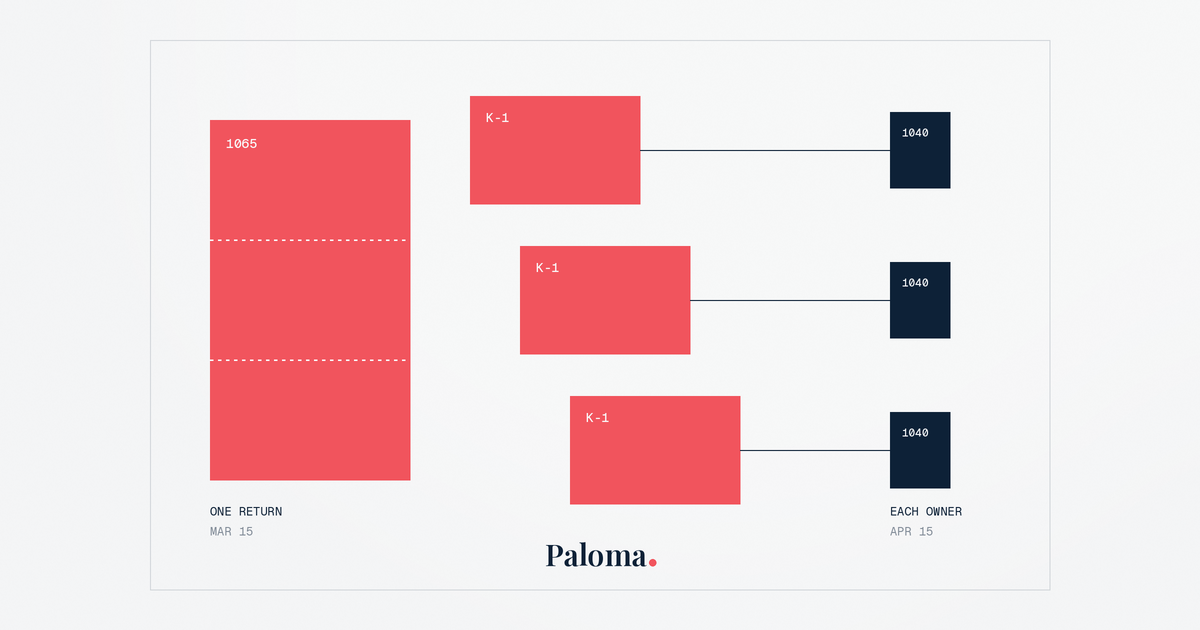
Multi Member LLC Taxes: Forms, Deadlines and a Checklist
How a multi member LLC is taxed: Form 1065, a K-1 for each member, guaranteed payments vs distributions, self employment tax and a filing checklist.
Read more →
LLC vs S Corp Taxes: How the Math Works and When to Switch
An LLC is a legal entity and an S corp is a tax election. See how each is taxed, a side by side example, and when electing S corp status pays off.
Read more →
How to File Taxes for a Single Member LLC: A Simple Checklist
A plain guide to filing taxes for a single member LLC: Schedule C, Schedule SE, payroll forms, state fees, deadlines and the mistakes to skip.
Read more →
Bookkeeping and Tax Services for Small Business: How They Fit
What a bookkeeper does, what your tax preparer does, the records the IRS expects you to keep, and how to set up both before the 2027 season.
Read more →Want someone to handle your taxes?
Paloma prepares returns for freelancers, small businesses and individuals, with a fixed quote within 24 hours.
Get your quoteReferences
- IRS: Limited liability company (LLC)
- IRS: Get an employer identification number
- IRS: Single member limited liability companies
- IRS: About Form 8832
- IRS: Form 8832, Entity Classification Election
- IRS: Instructions for Form 2553
- IRS: Recordkeeping
- Bizee: Can a CPA set up an LLC for a client?
- CorpNet: Can a CPA set up an LLC for a client?
- LegalZoom: Filing an LLC yourself vs. using a formation service
- 1800Accountant: LLC costs breakdown
- BiggerPockets: LLC, attorney, CPA or neither?