Jump to section

How to File Taxes for a Single Member LLC: A Simple Checklist
A plain guide to filing taxes for a single member LLC: Schedule C, Schedule SE, payroll forms, state fees, deadlines and the mistakes to skip.
·10 min read·Updated November 23, 2026·By Abby Melby
Key Takeaways
- By default a single member LLC is a disregarded entity, so the business shows up on your personal 1040, usually on Schedule C.
- If your Schedule C net profit is $400 or more, you also file Schedule SE.
- If you have employees, the LLC uses its own name and EIN for payroll taxes and files forms like 941, 940 and W-2.
- Individual returns are generally due April 15, and an extension gives you more time to file, not more time to pay.
- Your state may want its own return or an annual LLC fee, so check your state's site.
To file taxes for a single member LLC, you usually report the business on your personal Form 1040 using Schedule C, then add Schedule SE for self employment tax. By default the IRS doesn't want a separate federal business return from you, just those schedules attached to your own.
The rest of this guide walks through each step with a checklist you can use. If you'd rather hand the whole thing off, our online tax preparation for small businesses gives you a fixed quote within 24 hours, and every return is reviewed and signed off by a licensed tax professional before anything is filed.
What single member means for your taxes
The IRS treats a one owner LLC as a "disregarded entity" unless you choose otherwise. That means for federal income tax, the LLC isn't separate from you. Its income and expenses go on your own return.
According to the IRS page on single member limited liability companies, an individual owner usually reports the LLC on one of three schedules attached to Form 1040:
- Schedule C for most businesses (consulting, design, trades, online stores)
- Schedule E for rental real estate
- Schedule F for farming
There are two catches, though.
- Payroll and excise taxes are different. For employment taxes and certain excise taxes, the IRS treats your single member LLC as a separate entity. More on that below.
- You can elect a different tax treatment. An LLC can file Form 8832 to be taxed as a corporation, and some owners elect S corporation status with Form 2553. If you do, you file a business return instead, and the LLC needs its own EIN if it doesn't already have one. If you're weighing that, our guide to what S corp tax preparation takes walks through the business side.
Which forms do I file?
| Your situation | What you file federally |
|---|---|
| One owner, no election, regular business | Form 1040 with Schedule C, plus Schedule SE if net profit is $400 or more |
| One owner, no election, rental property | Form 1040 with Schedule E |
| One owner, no election, farm | Form 1040 with Schedule F |
| Any of the above, with employees | Add payroll forms in the LLC's name and EIN: Form 941 each quarter, Form 940 and W-2s each year |
| You paid a contractor for services | Form 1099-NEC to the contractor and the IRS |
| You elected S corporation status | Form 1120-S for the business, plus your own 1040 |
| You elected to be taxed as a corporation | Form 1120 for the business, plus your own 1040 |
Step 1: Gather your income and expense records
Schedule C asks for totals, and those totals are only as good as your records. Here's the filing checklist we'd use:
- Every Form 1099 you received (1099-NEC, 1099-K, 1099-MISC)
- Bank and credit card statements for the business accounts, all 12 months
- A profit and loss report from your bookkeeping, if you keep one
- Receipts or records for big purchases like equipment or a vehicle
- Mileage log, if you'll claim car expenses
- Home office square footage and total home square footage, if you work from home
- Records of any contractors you paid and how much
- Payroll reports, if you have employees
- Estimated tax payments you made during the year, with dates
- Last year's return, so carryovers don't get missed
- Your state's LLC annual report confirmation or fee receipt
If your books are a mess, that's common and fixable. Cleaning up the year first makes the return faster and more accurate, and we work with partner bookkeepers who can reconcile your accounts and categorize the year's transactions before your return.
Get your tax prep quote
A fixed quote within 24 hours, signed off by a licensed tax pro
Step 2: Fill out Schedule C, the key parts
Schedule C is called Profit or Loss From Business. The Schedule C instructions say that if you're the sole member of a domestic LLC, you file Schedule C unless you elected to be treated as a corporation.
The questions at the top
- Line F, accounting method. You can generally use cash, accrual or another permitted method.
- Line G, material participation. Checking "No" makes the activity passive, which changes how losses are treated.
- Line I, Forms 1099. Asks whether you made payments that require a Form 1099, like paying a contractor.
Part I: Income
- Line 1, gross receipts. The instructions say to report all income from your business from all sources, and to check your Forms 1099 for amounts that belong here.
- Line 2, returns and allowances. Refunds you gave customers go here as a positive number.
If you sell products, Part III covers cost of goods sold.
Part II: Expenses
A few expense lines that trip people up:
- Line 9, car and truck. You can deduct actual expenses or use the standard mileage rate. If you use the standard mileage rate, you also fill out Part IV.
- Line 13, depreciation. Bigger purchases like equipment are usually recovered through depreciation rather than deducted like supplies.
- Line 17, legal and professional services. Fees you pay accountants and attorneys for the business go here when they're ordinary and necessary.
- Line 18, office expense. Supplies and postage.
- Line 24, travel and meals. Overnight business travel goes on 24a. For meals on 24b, you can generally deduct only 50%.
- Line 30, business use of your home. Use Form 8829 or the simplified method.
Line 31: Net profit
Line 31 is your bottom line. The instructions say to carry your net profit or loss to Schedule 1 (Form 1040), line 3, and to Schedule SE, line 2.
A hypothetical example. Say you run a one person design studio as a single member LLC. You brought in $60,000 and had $12,000 of business expenses. Your Schedule C shows $48,000 on line 31. That $48,000 goes to Schedule 1, line 3, which flows into your 1040, and to Schedule SE, line 2.
Step 3: Add Schedule SE and finish your 1040
As the owner of a single member LLC, you pay self employment tax on your net earnings the same way a sole proprietor does. The IRS's business income topic says that if your net earnings from Schedule C are $400 or more, you file Schedule SE to figure the tax. The Social Security Administration also uses Schedule SE to figure your benefits.
You probably also need to pay estimated taxes during the year, since no one is withholding from your LLC profits. The IRS's estimated taxes page says individuals, including sole proprietors, generally need to make payments if they expect to owe $1,000 or more when they file, using Form 1040-ES. If you'd like someone else to track those payments, here's what to look for in a tax preparer for freelancers.
Your 1040 then pulls it together: Schedule C profit through Schedule 1, self employment tax from Schedule SE, and the estimated payments you already made.
If you're wondering whether an S corp election would actually lower your taxes, we ran the numbers side by side in LLC vs S corp taxes.
State filings and annual LLC fees
States handle LLCs in their own ways. Check your state's official website for:
- State income tax return. If your state has an income tax, your Schedule C income generally goes on your personal state return too.
- Annual report or LLC fee. Many states charge an annual report or similar fee to keep your LLC in good standing, separate from your tax return.
- Sales tax. If you sell taxable goods or services, your state may require you to register and file sales tax returns.
- State payroll accounts. If you have employees, your state likely has its own withholding and unemployment accounts.
A missed annual report can hurt your LLC's standing even if your taxes are perfect.
Start your return
Answer a short form about your year and upload documents from your phone
If you have employees: EIN and payroll forms
Do you need an EIN?
According to the IRS page on single member LLCs, a single member LLC with no employees and no excise tax liability doesn't need an EIN and can use the owner's name and taxpayer ID. You can still get one if your bank asks for it or your state requires it.
Once you have employees, it changes. The IRS says the LLC is "required to use its name and employer identification number (EIN)" for reporting and paying employment taxes. The IRS page on when to get a new EIN also says to get a new EIN if you own a single member LLC and have to file excise or employment taxes.
Payroll forms and due dates
From the IRS employment tax due dates page:
| Form | What it's for | When it's due |
|---|---|---|
| Form 941 | Quarterly federal payroll return | April 30, July 31, October 31 and January 31 |
| Form 940 | Annual federal unemployment (FUTA) return | January 31 |
| Forms W-2 and W-3 | Wage statements to employees and the SSA | January 31 |
| Form 1099-NEC | Payments to contractors, to the IRS and recipients | January 31 |
Federal tax deposits must be made electronically. If you deposit all your 941 or 940 taxes on time, the IRS gives you 10 extra calendar days to file those returns.
Deadlines and extensions
Because your LLC's income goes on your personal return, your main deadline is the individual one. The IRS topic on when to file says calendar year returns are generally due April 15, and if that day falls on a weekend or legal holiday, it moves to the next business day. For your tax year 2026 return, that's April 15, 2027.
Need more time? Form 4868 gets you an automatic six month extension to file. The same IRS topic on when to file is clear: "An extension of time to file is not an extension of time to pay." Interest can build on unpaid tax after the original due date, so estimate what you owe and pay it by April 15 even if the return comes later.
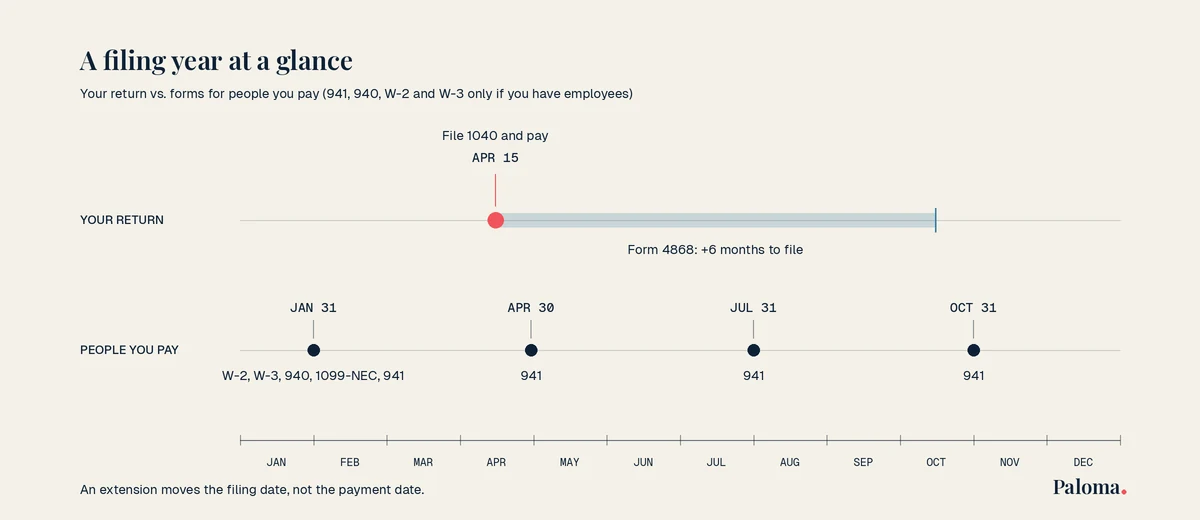
Here's the order of things for a typical single member LLC with no employees:
- Wrap up the year's books and gather your checklist items.
- Send any Forms 1099-NEC by January 31.
- Fill out Schedule C, then Schedule SE.
- Complete your 1040 and your state return.
- File and pay by April 15, or file Form 4868 and pay what you expect to owe.
Common mistakes to skip
- Filing a business return you don't need. By default there's no separate federal LLC return. Your business goes on your 1040.
- Reporting only what's on your 1099s. Line 1 is all your gross receipts, not just the amounts someone reported to you.
- Deducting 100% of meals. Business meals are generally limited to 50%.
- Skipping Schedule SE. If your net profit is $400 or more, you owe self employment tax even if your income tax is low.
- Running payroll under your Social Security number. Once you have employees, use the LLC's name and EIN.
- Forgetting the state. The annual report or fee is easy to miss because it isn't part of your federal return.
If you're not sure whether to do this yourself or get help, our guide on whether you need a CPA for your LLC helps you decide based on your setup. You can also browse all our tax guides.
Frequently Asked Questions
Does a single member LLC file a separate tax return?
Not by default. The IRS treats a single member LLC as a disregarded entity, so you report its income and expenses on your personal Form 1040, usually on Schedule C. You file a separate business return only if you elect to be taxed as a corporation or S corporation.
What form does a single member LLC use to file taxes?
Most use Schedule C attached to Form 1040, plus Schedule SE for self employment tax. Rental activity usually goes on Schedule E and farming on Schedule F.
Do I need an EIN for my single member LLC?
Not if you have no employees and no excise tax liability. The IRS says you need one once you have employees or excise tax obligations, and a new single member LLC that elects corporate or S corporation treatment needs one too. Some banks and states also ask for one.
When is the tax return due for a single member LLC?
Since the business goes on your personal return, it's generally due April 15. For tax year 2026, that's April 15, 2027. Form 4868 extends the time to file by six months but not the time to pay.
Can I deduct what I pay someone to do my LLC taxes?
Fees for tax advice and for preparing the tax forms related to your business go on Schedule C, line 17, with other legal and professional services. The part for your personal return is a different question, so ask your preparer.
Let us handle it
Filing for a single member LLC is mostly Schedule C, Schedule SE and a few deadlines, but getting the details right still takes time. If you'd like help, our online tax preparation for small businesses includes your federal return plus one state, an extension if needed, and a fixed quote within 24 hours. Upload your documents securely, sign online, and a licensed tax professional reviews every return before it's filed.
Get help with your taxes
Related Articles
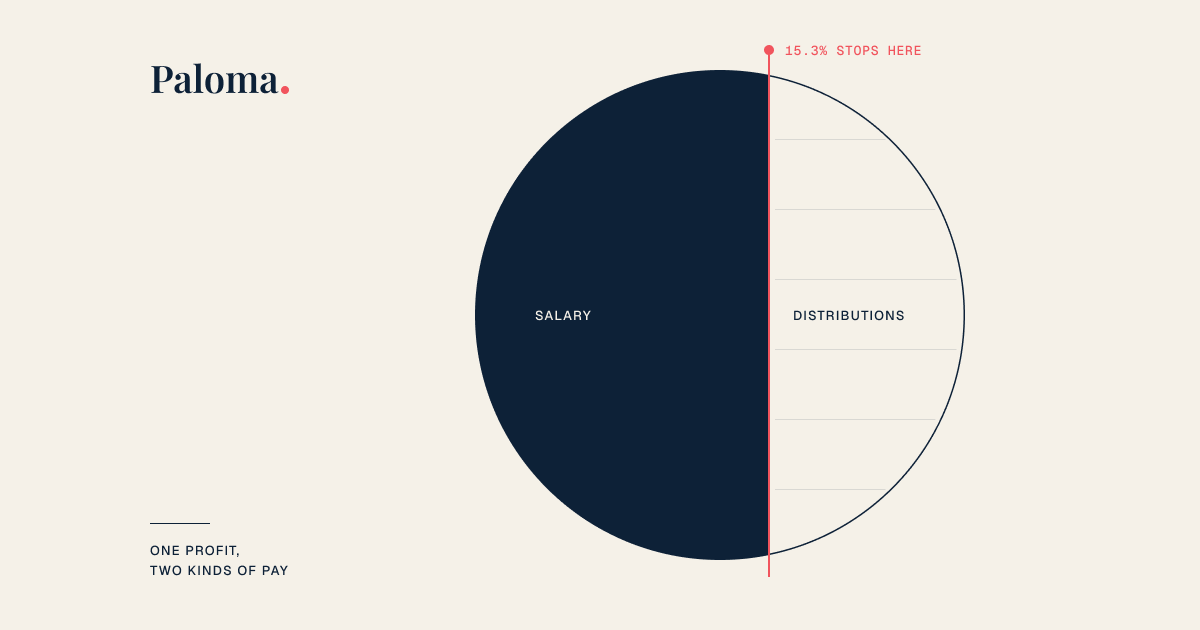
LLC vs S Corp Taxes: How the Math Works and When to Switch
An LLC is a legal entity and an S corp is a tax election. See how each is taxed, a side by side example, and when electing S corp status pays off.
Read more →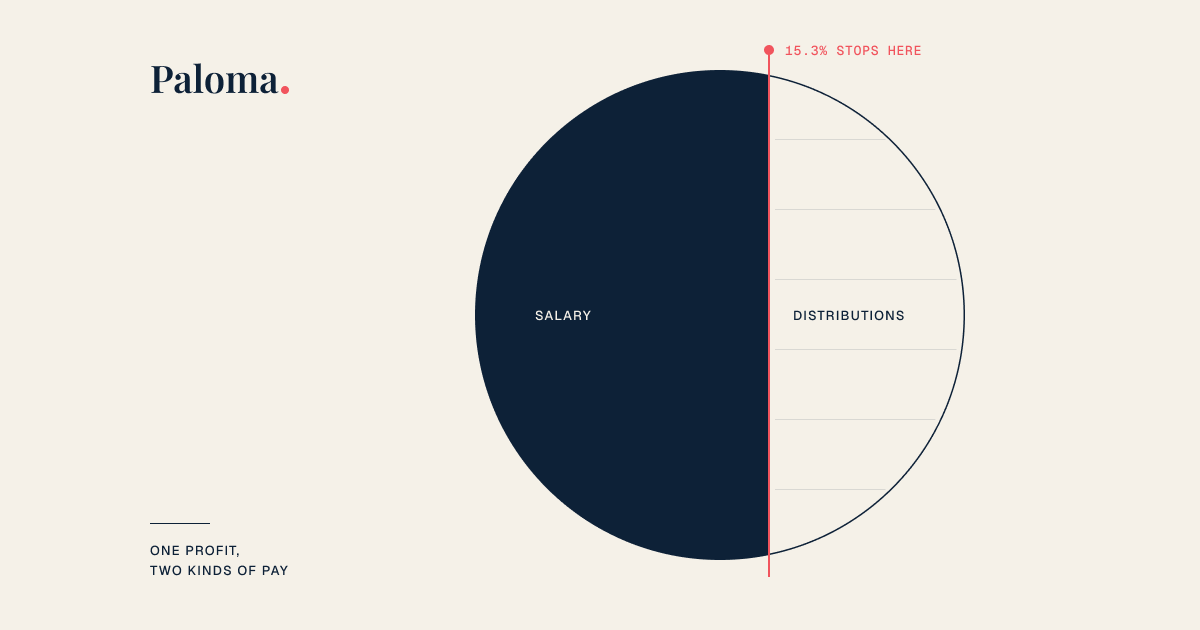
LLC vs S Corp Taxes: How the Math Works and When to Switch
An LLC is a legal entity and an S corp is a tax election. See how each is taxed, a side by side example, and when electing S corp status pays off.
Read more →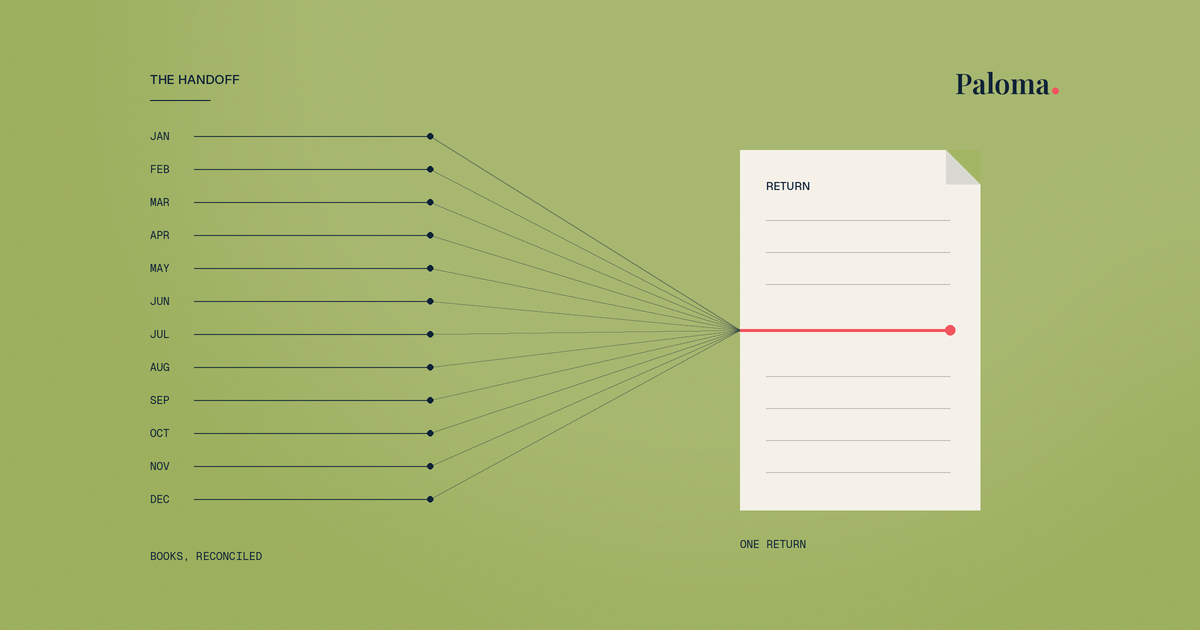
Bookkeeping and Tax Services for Small Business: How They Fit
What a bookkeeper does, what your tax preparer does, the records the IRS expects you to keep, and how to set up both before the 2027 season.
Read more →
Tax Preparer for Freelancers: What to Look For and Send
What a good tax preparer for freelancers does beyond April: quarterly estimates, self employment tax, 1099s and the records to send for 2027.
Read more →Want someone to handle your taxes?
Paloma prepares returns for freelancers, small businesses and individuals, with a fixed quote within 24 hours.
Get your quoteReferences
- IRS: Single member limited liability companies
- IRS: Limited liability company (LLC)
- IRS: Entities FAQs
- IRS: Instructions for Schedule C (Form 1040)
- IRS: Topic no. 407, Business income
- IRS: About Schedule SE (Form 1040)
- IRS: Estimated taxes
- IRS: When to get a new EIN
- IRS: Employment tax due dates
- IRS: Topic no. 301, When, how and where to file
- IRS: About Form 4868