Jump to section
Multi Member LLC Taxes: Forms, Deadlines and a Checklist
How a multi member LLC is taxed: Form 1065, a K-1 for each member, guaranteed payments vs distributions, self employment tax and a filing checklist.
·9 min read·By Abby Melby
Key Takeaways
- Two or more members means partnership rules unless you elect something else.
- For tax year 2026, Form 1065 and every member's K-1 are due March 15, 2027.
- You're taxed on your share of profit whether or not you took the cash out.
- Guaranteed payments and distributions are taxed differently, so label them right in your books.
- Most working members also owe self employment tax and should plan for quarterly estimates.
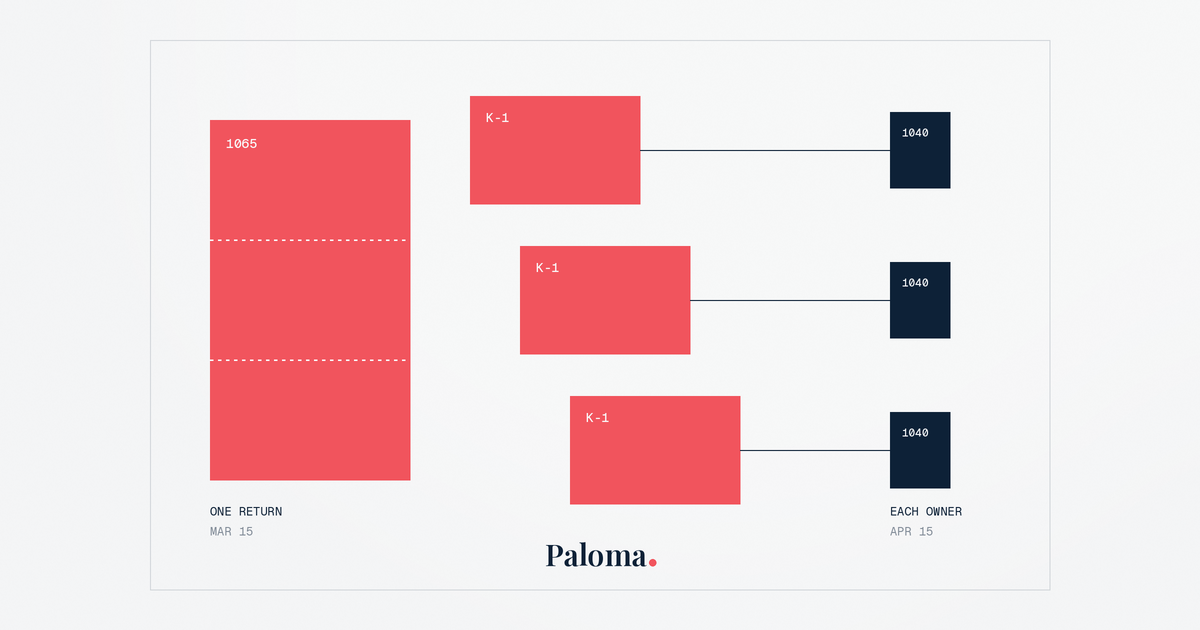
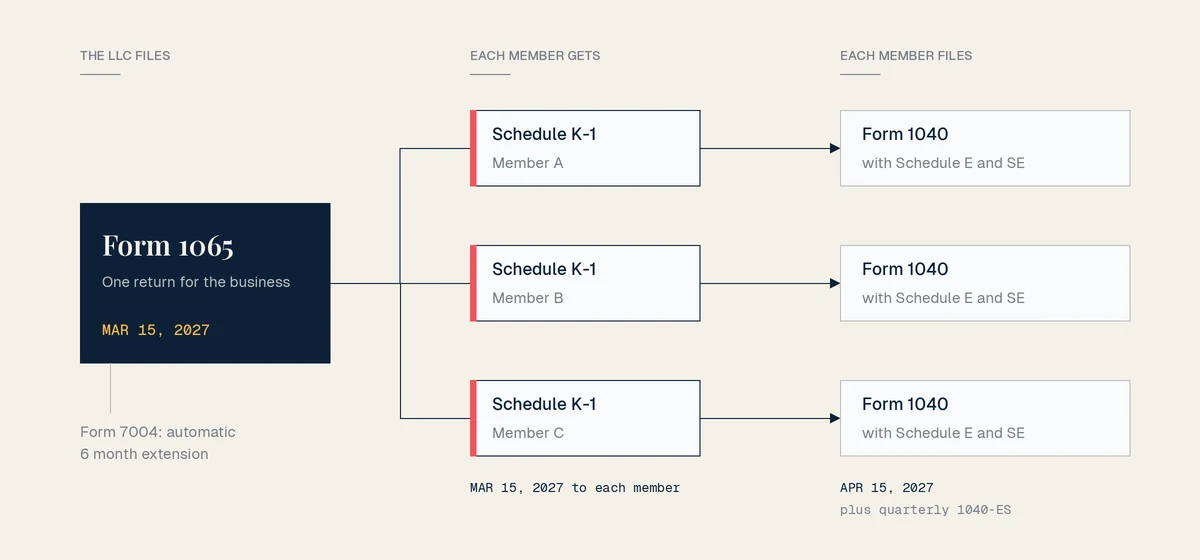
A multi member LLC is taxed as a partnership by default. The LLC files Form 1065, which reports income but usually pays no income tax itself, and each member gets a Schedule K-1 and pays tax on their share on their own return.
How the IRS sees a multi member LLC
The IRS says "a domestic LLC with at least two members is classified as a partnership for federal income tax purposes" unless it files Form 8832 and elects to be treated as a corporation (IRS). An LLC that's classified as a partnership has the same filing requirements as any other partnership (IRS).
What that means in plain terms:
- The LLC files a return but generally doesn't pay income tax. A partnership "passes through any profits or losses to its partners" (IRS).
- Each member pays tax on their share. Each partner reports their share of the partnership's income or loss on their personal return (IRS). How the shares are split is usually tied to ownership and set out in your operating agreement (Rocket Lawyer).
- Members aren't employees. The IRS says partners "shouldn't be issued a Form W-2" and get a Schedule K-1 instead (IRS).
This is a real jump from a single member LLC, where everything lands on your own Schedule C. If you just added a partner and want someone to handle the business return and every owner's 1040 together, our online tax preparation for small businesses covers Form 1065 and the owners' returns, starts with a fixed quote within 24 hours, and every return is reviewed and signed off by a licensed tax professional.
The forms, who files them and when
Here's the full set for a calendar year LLC with two or more members and no election, for tax year 2026.
| Form | Who files it | What it does | Due for tax year 2026 |
|---|---|---|---|
| Form 1065 | The LLC | Reports the business's income, deductions and each member's share | March 15, 2027 |
| Schedule K-1 (Form 1065) | The LLC, one per member | Tells each member what to report on their own return | March 15, 2027, to each member |
| Form 7004 | The LLC, if needed | Automatic 6 month extension for Form 1065 | By March 15, 2027 |
| Form 1040 with Schedule E and Schedule SE | Each member | Reports the member's share and figures self employment tax | April 15, 2027 |
| Form 1040-ES | Each member | Quarterly estimated tax, since nothing is withheld | Quarterly |
The IRS puts the Form 1065 due date at "the 15th day of the 3rd month after the end of the partnership's tax year," and each K-1 is due to the partner by that same date (IRS). Form 7004 gives the partnership an automatic 6 month extension to file Form 1065 (IRS). Form 1040 is due on the 15th day of the 4th month, which is April 15, 2027 (IRS).
Two things owners miss here:
- Every member waits on the 1065. You can't finish your personal return without your K-1. We covered why that makes the business return the first domino in do I need a CPA for my LLC, so I'll keep it short.
- The late penalty multiplies by the number of members. The IRS figures it for each month or part of a month the return is late, up to 12 months, times the number of partners. There's a separate penalty for each K-1 that isn't furnished on time (IRS).
One exception worth knowing: a domestic partnership doesn't have to file Form 1065 if it "neither receives income nor incurs any expenditures" that count as deductions or credits (IRS). Once there's any activity, plan on filing.
Get your tax prep quote
A fixed quote within 24 hours, signed off by a licensed tax pro
Your Schedule K-1: what it is and what to do with it
The K-1 is your slice of the business. The LLC "files a copy of Schedule K-1 (Form 1065) with the IRS to report your share of the partnership's income" (IRS), and gives you a copy too.
What to know as a member:
- You're taxed on your share, not on what you took out. The IRS says you may owe "tax on your share of the partnership income, whether or not distributed" (IRS). So a profitable year with no cash pulled out can still mean a tax bill.
- Keep it, don't attach it. The K-1 instructions say "Don't file it with your tax return unless you're specifically required to do so" (IRS).
- Box 14 feeds your self employment tax. If you and your spouse are both members, each of you files your own Schedule SE (IRS).
- Health insurance the LLC paid for you shows up on your K-1. You may be able to deduct it on Schedule 1 of your 1040 even if you don't itemize (IRS).
Guaranteed payments vs distributions
This is where most multi member LLC books get messy, because both look like "money I paid myself."
Guaranteed payments are payments the LLC makes to a member that are set without regard to the LLC's income, like a fixed yearly amount for running the business. The partnership generally deducts them, lists them on the member's K-1, and the member reports them on Schedule E as ordinary income. No income tax is withheld from them (IRS).
Distributions are cash or property you take out of the LLC. They don't change your share of profit. They reduce your basis in the LLC, and they generally only create a taxable gain when the cash you receive is more than your basis (IRS). Your K-1 reports them separately in box 19 (IRS).
A side by side example (hypothetical)
Two members own an LLC 50/50. One works in the business full time and gets a $40,000 guaranteed payment. The LLC earns $100,000 before that payment, so $60,000 is left to split.
| Working member | Silent member | |
|---|---|---|
| Guaranteed payment | $40,000 | $0 |
| Share of remaining profit (50%) | $30,000 | $30,000 |
| Total reported on their return | $70,000 | $30,000 |
| Cash each took out during the year | $50,000 | $10,000 |
The cash column doesn't change the totals. The silent member reports $30,000 even though they only took out $10,000. That's the surprise a lot of new partners hit, so it's worth talking about cash for taxes when you write your operating agreement.
Self employment tax for members
The IRS self employment tax rate is 15.3%: 12.4% for Social Security and 2.9% for Medicare (IRS). You owe it if your net earnings from self employment are $400 or more, and for 2026 the Social Security part stops at $184,500 of self employment income (IRS).
How it applies to partners, from the Schedule SE instructions (IRS):
- General partners pay self employment tax on their share of certain partnership income and on their guaranteed payments.
- Limited partners include "only guaranteed payments for services actually rendered."
The instructions don't spell out a simple rule for LLC members, and where you land depends on your role in the business. If you work in the business, plan on owing it. If you only invested, that's a conversation to have with your preparer before you file, not a box to guess at.
Because nothing is withheld, most working members pay quarterly. Form 1040-ES is for income "not subject to tax withholding," including self employment earnings (IRS). You can also deduct the employer equivalent portion of your self employment tax when figuring your adjusted gross income (IRS).
Start your return
Answer a short form about your year and upload documents from your phone
State filing: check yours early
Your state may want its own partnership return, with its own due date and its own rules for members who live out of state. Utah is a good example. Its partnership return is the TC-65, due on the 15th day of the fourth month after year end (or the federal due date if later), and the partnership may have to withhold Utah tax for nonresident members (Utah State Tax Commission). Look up your state's rules before the federal return is done, not after.
What about an S corp election?
You may hear that having your LLC taxed as an S corporation could save money, because it changes how working members get paid. Whether it fits is a math question, and we walked through it in LLC vs S corp taxes, so I won't repeat it here.
Multi member LLC tax checklist
Use this for tax year 2026.
Before December 31
- Every member's ownership percentage matches the operating agreement
- Guaranteed payments and distributions are booked to separate accounts, by member
- Every business dollar ran through the business bank account
- Each working member has a plan for quarterly estimates
January and February
- Books closed and reconciled for the year
- Capital contributions and new money in from each member recorded
- Any ownership change during the year noted with the date
- Each member's mailing address and taxpayer ID confirmed for their K-1
- Your state's partnership return and withholding rules checked
By March 15, 2027
- Form 1065 filed, or Form 7004 filed for the extension
- A Schedule K-1 sent to every member
- State partnership return or extension handled
By April 15, 2027
- Each member reports their K-1 on Form 1040 with Schedule E and Schedule SE
- Each member's first 2027 estimated payment planned
If you only have one owner, this isn't your list. Our single member LLC tax checklist walks through Schedule C step by step.
Frequently Asked Questions
Does a multi member LLC pay taxes?
Usually not at the business level. By default it's a partnership, so it files Form 1065 and passes profit or loss through to members, who pay tax on their own returns.
When is Form 1065 due for tax year 2026?
March 15, 2027 for a calendar year LLC, and each member's K-1 is due the same day. Form 7004 gives an automatic 6 month extension to file.
Do I pay tax on money I didn't take out of the LLC?
Yes, generally. You're taxed on your share of the profit whether or not it was distributed to you.
Are guaranteed payments the same as a salary?
Not quite. They're often paid for your work, but you're not an employee, there's no W-2 and nothing is withheld. You report them as ordinary income and they generally count toward self employment tax.
Do all LLC members pay self employment tax?
Members who work in the business generally do. Members who are only investors may be treated differently, so talk it through with your preparer.
Can one member file the 1065 and the others skip it?
The LLC files one Form 1065 for the whole business. Every member still files their own personal return using their K-1.
Can a multi member LLC file a Schedule C instead?
Not under the default rules. With two or more members, the IRS treats the LLC as a partnership, which files Form 1065.
Want help with the partnership return?
A multi member LLC means one business return and a personal return for every owner, and they all have to line up. Our online tax preparation for small businesses handles the 1065 and the owners' 1040s together, includes federal plus one state return, includes an extension if you need one, and works with partner bookkeepers if your books need cleanup. You can also grab a time to chat or browse our small business tax guides.
Get help with your taxes
Related Articles

Can a CPA Set Up an LLC? What They Can and Can't Do
A CPA can file your LLC paperwork, get your EIN and pick your tax setup, but legal documents belong to an attorney. Here's who should do what.
Read more →
LLC vs S Corp Taxes: How the Math Works and When to Switch
An LLC is a legal entity and an S corp is a tax election. See how each is taxed, a side by side example, and when electing S corp status pays off.
Read more →
How to File Taxes for a Single Member LLC: A Simple Checklist
A plain guide to filing taxes for a single member LLC: Schedule C, Schedule SE, payroll forms, state fees, deadlines and the mistakes to skip.
Read more →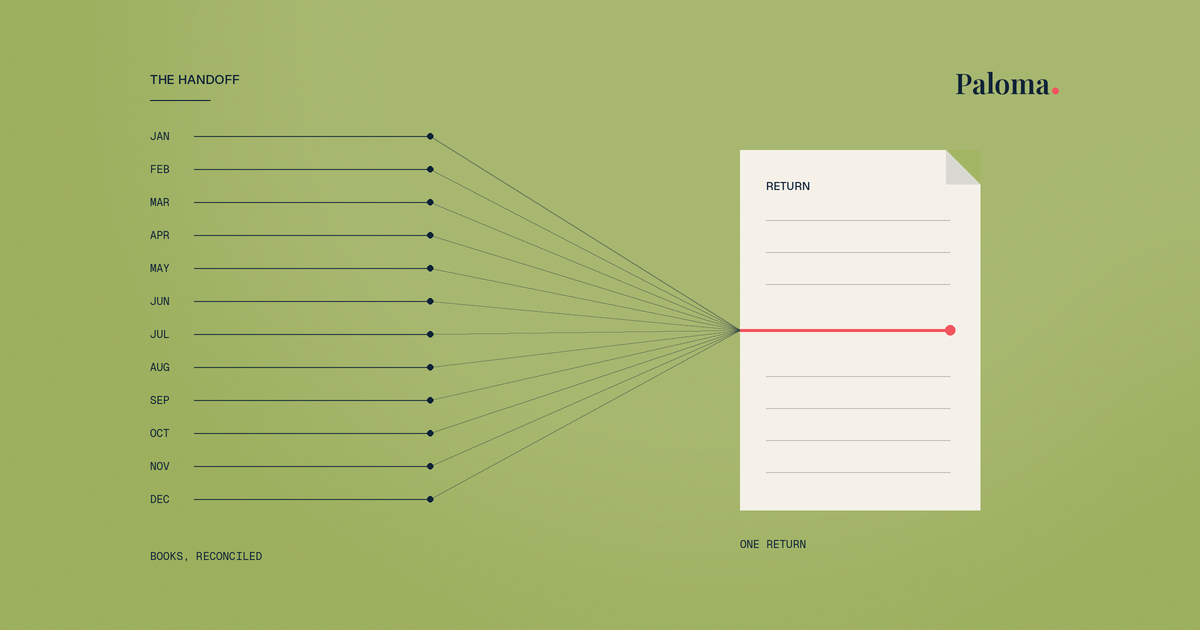
Bookkeeping and Tax Services for Small Business: How They Fit
What a bookkeeper does, what your tax preparer does, the records the IRS expects you to keep, and how to set up both before the 2027 season.
Read more →Want someone to handle your taxes?
Paloma prepares returns for freelancers, small businesses and individuals, with a fixed quote within 24 hours.
Get your quoteReferences
- IRS: Limited liability company (LLC)
- IRS: Partnerships
- IRS: About Form 1065
- IRS: Instructions for Form 1065
- IRS: Partner's Instructions for Schedule K-1 (Form 1065)
- IRS: Publication 541, Partnerships
- IRS: Publication 541 (PDF)
- IRS: Publication 509, Tax Calendars
- IRS: Instructions for Schedule SE (Form 1040)
- IRS: Self employment tax (Social Security and Medicare taxes)
- IRS: About Form 1040-ES
- Utah State Tax Commission: TC-65 Instructions
- Rocket Lawyer: How are multi member LLCs and their members taxed?