Jump to section
Bookkeeping and Tax Services for Small Business: How They Fit
What a bookkeeper does, what your tax preparer does, the records the IRS expects you to keep, and how to set up both before the 2027 season.
·8 min read·By Abby Melby
Key Takeaways
- A bookkeeper keeps your books current all year. A tax preparer uses those books to file your return and plan next year's payments.
- The IRS says your books must show your gross income, deductions and credits, and you have to be able to prove expenses to deduct them.
- Most records need to be kept at least 3 years, employment tax records at least 4, and some much longer.
- You can hire one firm for both or two that work together. What matters is that the handoff is planned before tax season, not in March.
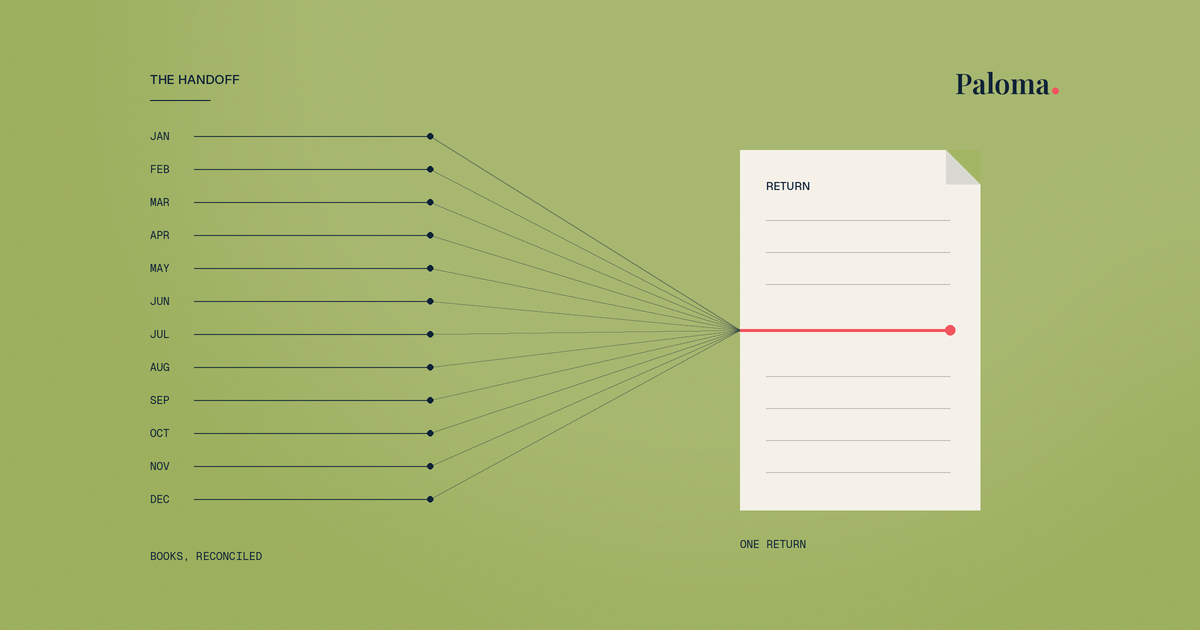
Bookkeeping and tax services are two different jobs that depend on each other. Your bookkeeper records and reconciles every transaction during the year. Your tax preparer turns those finished books into a return. When the books are clean, the return is faster, cheaper and easier to defend if the IRS ever asks.
We already covered what tax prep costs and why cleanup is priced on its own in how much it costs to have business taxes done. This post is about how the two services fit together, so you can set yours up the right way.
What a bookkeeper does vs. what a tax preparer does
People use "my accountant" for both, which is how things fall through the cracks. Here's who usually owns what.
| Task | Bookkeeper | Tax preparer |
|---|---|---|
| Record and categorize transactions | Yes, all year | Reviews the totals |
| Reconcile bank, credit card and payment accounts | Yes, usually monthly | Asks that it's done before starting |
| Track receipts and invoices | Yes | Asks for them when something needs proof |
| Run payroll | Sometimes, or a payroll provider | Uses the payroll reports |
| Prepare your business return and your 1040 | No | Yes |
| Figure next year's estimated payments | No | Yes |
| Answer IRS letters about your return | Pulls the records | Explains the return |
| Tell you when your setup should change | Sometimes spots it | Yes, with the numbers |
The short version: your bookkeeper owns the records, your tax preparer owns the return. Each one is only as good as the other's work.
Why the return is only as good as the books
The IRS lets you use any recordkeeping system that fits your business, as long as it "clearly shows your income and expenses." It also says your books must show your gross income, as well as your deductions and credits (IRS).
That's the bar your tax preparer is working from. Every number on your return comes from your books, and your books come from your bank. The IRS puts it plainly: for most small businesses, the business checking account is the main source for entries in the business books.
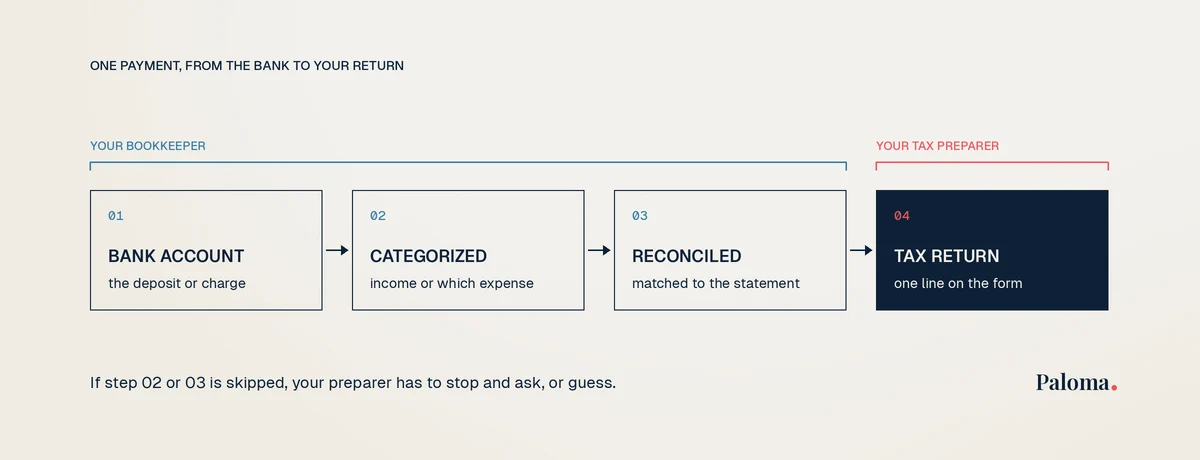
So when a deposit is never categorized, or a personal charge sits in the business card, your preparer has two choices. Stop and ask you about it, or guess. A good preparer stops. That's where the delays and the extra fees come from.
The other half is proof. The IRS says you must be able to prove certain elements of expenses to deduct them (IRS). Supporting documents include sales slips, paid bills, invoices, receipts, deposit slips and canceled checks. A bookkeeper who attaches the receipt when the expense is recorded saves you from digging for it a year later.
Get your tax prep quote
A fixed quote within 24 hours, signed off by a licensed tax pro
Monthly bookkeeping vs. a once a year cleanup
There are two common ways small businesses handle their books.
Monthly. A bookkeeper categorizes and reconciles your accounts every month. By January, the year is already closed and your preparer can start as soon as your tax forms arrive. You also get real numbers during the year, which helps when you're setting estimated payments or deciding whether to hire.
Once a year. Nobody touches the books until tax season. Then a bookkeeper does a cleanup project: twelve months of bank feeds, card statements and payment apps, all at once, while you try to remember what a charge from last March was for.
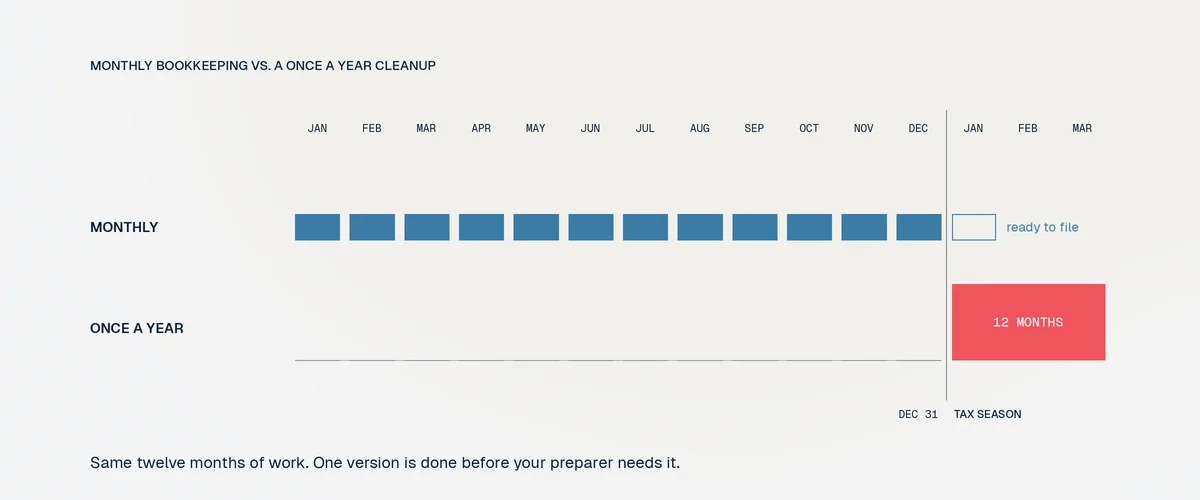
Monthly is usually the better fit once you have regular transactions, payroll, or more than one owner. A once a year cleanup can work for a very simple sole proprietor with a handful of transactions. Either way, the books need to be reconciled through December 31 before the return can be finished. If your business is an S corp, we covered why that matters so much in our guide to S corp tax preparation.
Records the IRS expects you to keep, and for how long
This is the part most bookkeeping and tax pages skip, and it's the part that matters if you ever get a letter from the IRS.
What to keep. The IRS lists the kinds of documents that support your books (IRS):
- Gross receipts: cash register tapes, deposit information, receipt books, invoices and Forms 1099-MISC
- Purchases and expenses: canceled checks or other proof of payment, credit card receipts and statements, account statements and invoices
- Assets: purchase and sales invoices, real estate closing statements, and proof of payment, plus when you got the asset, what you paid, improvements, depreciation and when you sold it
The IRS also says all requirements that apply to paper records apply to electronic records too, so scanned receipts in your bookkeeping software follow the same rules.
How long to keep it. The general rule is to keep records that support your return until the period of limitations for that return runs out (IRS). For most returns that's 3 years. It runs longer in a few cases:
- Keep employment tax records for at least 4 years after the tax is due or paid, whichever is later.
- If you don't report income you should have, and it's more than 25% of the gross income on your return, it's 6 years.
- If you claim a loss from worthless securities or a bad debt deduction, it's 7 years.
- Keep property records until the period of limitations runs out for the year you sell or dispose of it.
- If you never filed, or filed a fraudulent return, keep records indefinitely.
The IRS also reminds you to keep copies of your filed returns, and to check whether your insurance company or lenders need records kept longer before you throw anything out.
In practice, a good bookkeeper keeps these organized for you, and a good tax preparer keeps a copy of every return they file for you.
One firm or two?
You can get bookkeeping and tax services from one firm, or hire a bookkeeper and a tax preparer who work together. Both work. Here's how to think about it.
One firm is simpler. One portal, one point of contact, and nobody has to email your books from one office to another. The tradeoff is that you're relying on one team to be strong at both.
Two specialists can work well if you already have a bookkeeper you love, or your industry needs someone who knows its quirks. The tradeoff is the handoff. Someone has to own getting the reconciled books to the preparer by a set date.
What matters more than the setup is the plan. Before the season starts, ask:
- Who reconciles each bank, credit card and payment account, and how often?
- By what date will the books be closed through December 31?
- How will the books get to the tax preparer, and in what format?
- Who collects the 1099s, payroll reports and loan statements?
- Who answers if the preparer finds a transaction that doesn't make sense?
- Is the cleanup quoted separately from the return, and do you get both quotes up front?
- Where are your documents uploaded, and is it a secure portal instead of email?
If nobody can answer the third question, that's your sign to fix it now and not in March.
Start your return
Answer a short form about your year and upload documents from your phone
How it works at Paloma
At Paloma, we prepare returns for small businesses, freelancers and individuals, and we partner with bookkeepers who reconcile your accounts and categorize the year's transactions before we start. That means your bank accounts, credit cards and payment accounts are reconciled and your transactions are categorized for the tax year, so the return is built on books that tie out.
You get a fixed quote within 24 hours based on the documents you share, and if anything new comes up, we quote it and you approve it before we do the work. Every return is reviewed and signed off by a licensed tax professional, your federal return and one state return are included, and documents come in through a secure upload, never by email. You can see the returns we prepare on our online tax preparation for small businesses page.
If you're a freelancer and your books mostly live in payment apps, our guide on finding a tax preparer for freelancers covers what to send and what to ask.
Frequently Asked Questions
Do I need both a bookkeeper and a tax preparer?
Not always. A simple sole proprietor with a few transactions may be fine keeping their own books and hiring only a tax preparer. Once you have regular transactions, payroll, inventory or more than one owner, having someone keep the books during the year usually saves time and money at tax time.
Can my tax preparer do my bookkeeping?
Some can. Many preparers expect your books to be reconciled before they start and price any cleanup separately. Ask up front whether they do the books themselves, work with a partner bookkeeper, or expect you to bring finished books.
What's the difference between bookkeeping and accounting?
Bookkeeping is recording and reconciling transactions. Accounting and tax work uses those records to prepare financial statements and returns and to plan ahead. Your bookkeeper builds the records, your tax preparer works from them.
How long should a small business keep tax records?
Generally until the period of limitations for that return runs out, which is usually 3 years. The IRS says to keep employment tax records at least 4 years, and longer in some cases, like 6 years for underreported income over 25% or 7 years for a bad debt deduction.
Does the IRS require a specific bookkeeping system?
No. The IRS says that except in a few cases, the law does not require any special kind of records. You can use any system that clearly shows your income and expenses, and electronic records follow the same rules as paper ones.
When should I hire bookkeeping help for tax season?
Before the year ends, if you can. A bookkeeper who starts in the fall can catch up the year and close it right after December 31. Starting in March means your return waits on the cleanup.
What do I send my tax preparer if I have a bookkeeper?
Your year end reports from the books (profit and loss and balance sheet), plus your tax forms like 1099s and W-2s, payroll reports, loan statements and last year's return. Your preparer will tell you if anything else is needed.
Getting your books and taxes on the same page
The best setup is the one where your books are closed and reconciled before your preparer starts, and everyone knows who owns what. If you'd like us to take both off your plate this season, see our online tax preparation for small businesses, browse more tax guides for business owners, or book a free call with me and we'll see if we're a good fit.
Get help with your taxes
Related Articles

LLC vs S Corp Taxes: How the Math Works and When to Switch
An LLC is a legal entity and an S corp is a tax election. See how each is taxed, a side by side example, and when electing S corp status pays off.
Read more →
LLC vs S Corp Taxes: How the Math Works and When to Switch
An LLC is a legal entity and an S corp is a tax election. See how each is taxed, a side by side example, and when electing S corp status pays off.
Read more →
How to File Taxes for a Single Member LLC: A Simple Checklist
A plain guide to filing taxes for a single member LLC: Schedule C, Schedule SE, payroll forms, state fees, deadlines and the mistakes to skip.
Read more →
Tax Preparer for Freelancers: What to Look For and Send
What a good tax preparer for freelancers does beyond April: quarterly estimates, self employment tax, 1099s and the records to send for 2027.
Read more →Want someone to handle your taxes?
Paloma prepares returns for freelancers, small businesses and individuals, with a fixed quote within 24 hours.
Get your quote