Jump to section

Hiring Someone to Do Your Business Taxes: What to Know
Who to hire for your business taxes, what it costs, the IRS red flags, what you'll sign and what to hand over, matched to your type of business.
·7 min read·Updated November 12, 2026·By Abby Melby
Key Takeaways
- Anyone paid to prepare your return needs a PTIN, but only CPAs, enrolled agents and attorneys can represent you in every IRS matter.
- S corp returns are due March 15, a full month before your personal return.
- Get a written fee up front. Never work with someone who charges a percentage of your refund.
- You're still responsible for what's on your return, so review it before you sign.
To hire someone to do your business taxes, match the preparer to your business type (a sole prop files differently than an S corp), check their credentials in the IRS directory, get the fee and what it includes in writing, and hire before January so you're not scrambling at the first deadline.
Signs it's time to stop doing it yourself
Plenty of owners file their own taxes for the first year or two. It usually stops working when one of these shows up:
- You formed an LLC or elected S corp status
- You have employees, contractors or inventory
- You got an IRS or state notice you're not sure how to answer
- You're spending weekends on receipts instead of your business
If any of those sound familiar, it's worth paying someone. The rest of this post is how to hire the right one.
Match the preparer to your business
Most hiring guides skip this part, but it's the most important one. The return you file depends on how your business is set up, and so does the deadline. Here's the 2027 filing season (for tax year 2026), using dates from the IRS's draft 2027 tax calendar.
| Your business | What gets filed | Due (calendar year) | What to ask a preparer |
|---|---|---|---|
| Sole prop or 1099 freelancer | Schedule C with your Form 1040 | April 15, 2027 | Do you help with quarterly estimated taxes? |
| Single member LLC | Usually Schedule C with your Form 1040 | April 15, 2027 | Do you also file my state LLC report? |
| S corp | Form 1120-S, a K-1 for each owner, then your Form 1040 | March 15, 2027 (business), April 15 (you) | Do you handle reasonable salary and payroll? |
| Just you, no business | Form 1040 | April 15, 2027 | What's included and what costs extra? |
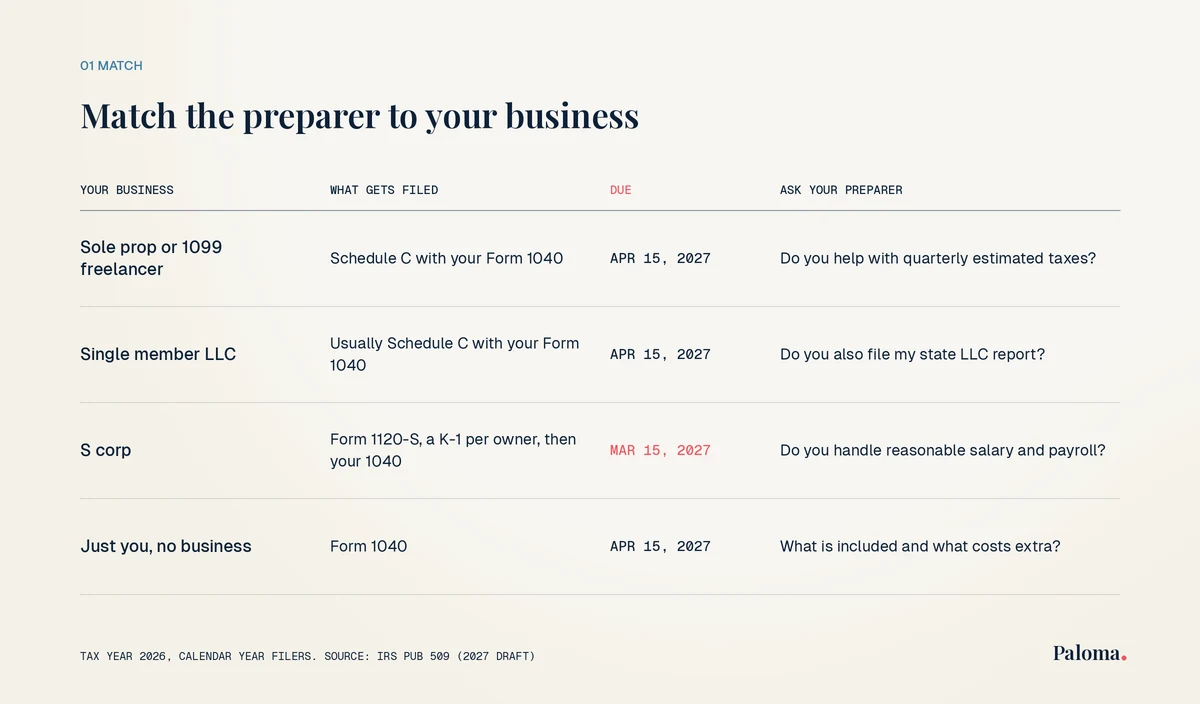
That March 15 date catches a lot of S corp owners. The business return comes first, because your personal return needs the K-1 from it. If you need more time, the IRS calendar shows Form 7004 gives the business an automatic 6 month extension, and Form 4868 extends your personal return to October 15. An extension gives you more time to file, not more time to pay.
Get your tax prep quote
A fixed quote within 24 hours, signed off by a licensed tax pro
Know what the credentials mean
The IRS says paid preparers must have a PTIN (preparer tax identification number) and must sign your return with it (IRS Topic 254). That's the floor. What really separates preparers is who can stand up for you if the IRS writes back.
Here's how the IRS breaks it down (IRS):
- CPAs, enrolled agents (EAs) and attorneys have unlimited representation rights. They can handle audits, payment issues and appeals for you.
- Annual Filing Season Program participants can represent you only on returns they prepared and signed, and not in appeals or collections.
- Preparers with only a PTIN can't represent you before the IRS at all.
For a simple Schedule C, a non credentialed preparer may be fine. For an S corp, or if you've had IRS letters before, I'd want someone who can represent you. You can look anyone up in the IRS Directory of Federal Tax Return Preparers, which is linked from IRS Topic 254.
What it costs
Fees vary a lot by where you live and how messy your books are. The best recent numbers come from the National Association of Tax Professionals' 2025 fee study, which found (Accounting Today):
- An average hourly rate of $182
- An average minimum fee of $634 for business returns
- About $123 to $135 added for a Schedule C on a personal return
Most preparers quote a flat fee instead of hourly. Before you agree, ask what's included: your state return, K-1s, quarterly estimates, answering IRS letters, and next year's planning. If your books need cleanup first, that's usually priced separately.
Questions to ask before you hire
Use this as your checklist on the first call:
- Are you a CPA, EA or attorney, and can you represent me if the IRS contacts me?
- How many clients do you have with my type of business?
- What's your fee, and what does it include?
- Are you available after April, or only during tax season?
- Do you e-file?
- How do I send you documents? (The answer should not be "just email them.")
- When do you need everything from me to hit my deadline?
- Will I get a copy of my return before and after it's filed?
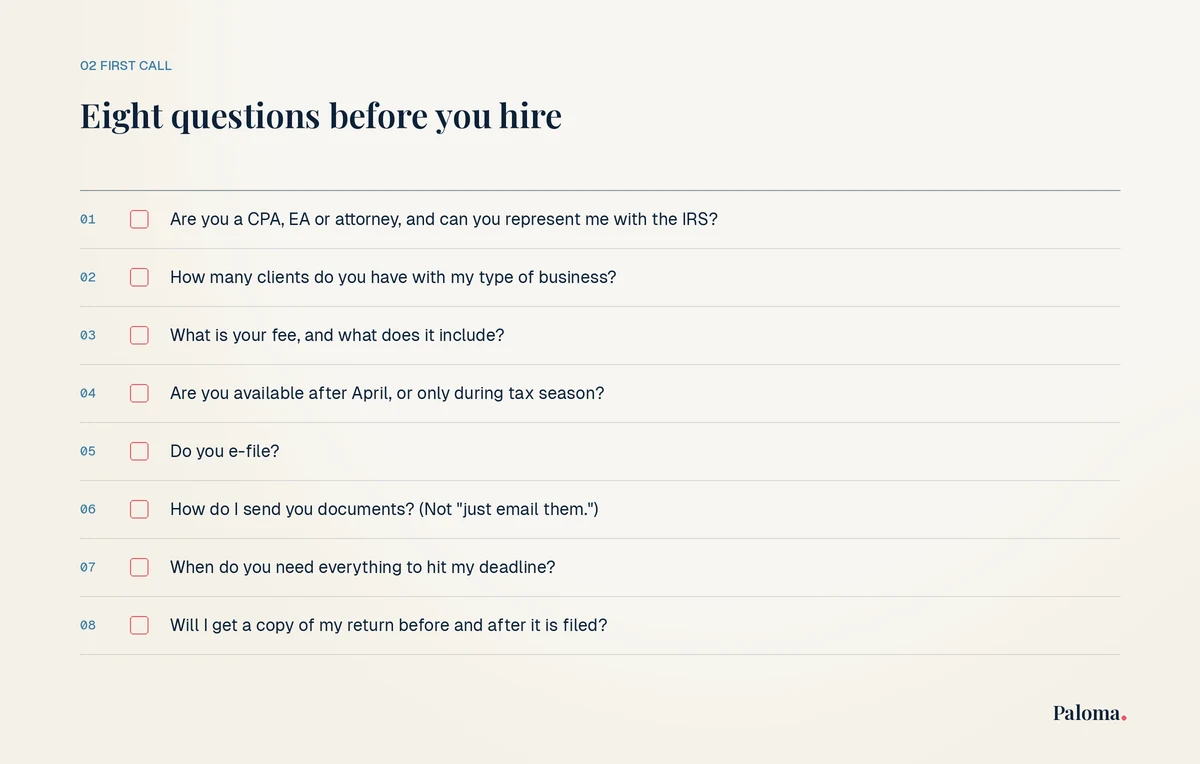
That document question matters more than it looks. Your return has your Social Security number, bank details and your business's income in one place. At Paloma, clients upload everything through a secure portal instead of email, and that's the bar I'd hold any preparer to.
Start your return
Answer a short form about your year and upload documents from your phone
Red flags the IRS warns about
The IRS lists a few things that should make you walk away (IRS Tax Tip):
- A fee based on a percentage of your refund
- Asking you to sign a blank or incomplete return
- A preparer who won't sign the return or include their PTIN
- Promises of a bigger refund than anyone else can get
- Wanting your refund deposited into their account
Good preparers also ask to see your records and receipts. If someone is happy to file from a one line summary of your income, that's not a good sign.
What you'll sign
Expect to sign an engagement letter that spells out the work and the fee. If you want your preparer to deal with the IRS for you, there are two different IRS forms (IRS Topic 311):
- Form 8821 lets them see your tax information, but they can't speak for you or argue your case.
- Form 2848 (power of attorney) lets them represent you before the IRS. Only someone authorized to practice before the IRS can be named on it.
If your preparer is a CPA, EA or attorney, a 2848 is usually the one you want.
What to hand over
The IRS groups business records into a few buckets (IRS). Have these ready, or ask your preparer which ones they need:
- Income: invoices, deposit records and any 1099s you received
- Expenses and purchases: receipts, credit card and bank statements, canceled checks
- Assets: what you bought (equipment, vehicles, property), when and for how much
- Payroll: W-2s, payroll reports and the 1099-NECs you sent contractors
- Last year's return, business and personal
If your books aren't up to date, say so on the first call. Paloma's tax services include partner bookkeepers who can reconcile your accounts before your return. Catching up bookkeeping before tax season is much cheaper than doing it in March.
When to hire
Earlier is better. The more time your preparer has before the first deadline, the more time there is to catch problems. A good order for the 2027 season:
- November to December: pick your preparer and sign the engagement letter
- January: send documents. Your 1099-NECs and W-2s to workers are due February 1, 2027
- February: answer your preparer's questions
- March 15: S corp return due (or extension filed)
- April 15: your personal return due (or extension filed)
Frequently Asked Questions
Who should I hire to do my business taxes?
For a sole prop or single member LLC, any experienced preparer with a PTIN can file your return, though a CPA or EA can also represent you if the IRS has questions. For an S corp, look for a CPA or EA who works with S corps regularly.
What's the difference between a CPA and an enrolled agent?
CPAs are licensed by state boards of accountancy, and enrolled agents are licensed by the IRS after passing a three part exam. Both have unlimited rights to represent you before the IRS.
How much does it cost to have someone do my business taxes?
It depends on your business type and how organized your books are. The NATP's 2025 study found an average minimum fee of $634 for business returns and an average hourly rate of $182. Always get a written quote first.
Can my tax preparer handle an IRS audit?
Only if they're a CPA, EA or attorney, or an Annual Filing Season Program participant for a return they prepared (with limits). You'd sign Form 2848 to authorize them.
Can I hire a tax preparer in another state?
Yes. Federal returns can be prepared remotely. Ask whether they file returns for your state, and how they'll collect your documents securely.
When is my S corp tax return due?
For a calendar year S corp, Form 1120-S for tax year 2026 is due March 15, 2027. Form 7004 gives an automatic 6 month extension to file.
Am I still responsible if my preparer makes a mistake?
Yes. The IRS says you're ultimately accountable for everything on your return, so review it before you sign.
Paloma prepares returns for freelancers, small businesses, S corps and individuals, and our partner bookkeepers can get your books ready first. If you'd like help this season, see our online tax preparation for small businesses and get a fixed quote within 24 hours, or book a free call with me and we'll see if we're a good fit.
Get help with your taxes
Related Articles

Engagement Letter for Tax Preparers: Clauses and Template
The clauses every tax prep engagement letter needs, the mistakes that cause scope creep and fee fights, and a plain language template you can adapt.
Read more →
Do I Need a CPA for My LLC? How to Decide for Your Setup
No law says your LLC needs a CPA. Here's how your LLC is taxed, when filing yourself works, and the moments when paying for help makes sense.
Read more →
Tax Document OCR: How It Works and Where It Breaks
How tax document OCR reads W-2s, 1099s and K-1s, where it gets values wrong, and how small tax firms can review the output fast.
Read more →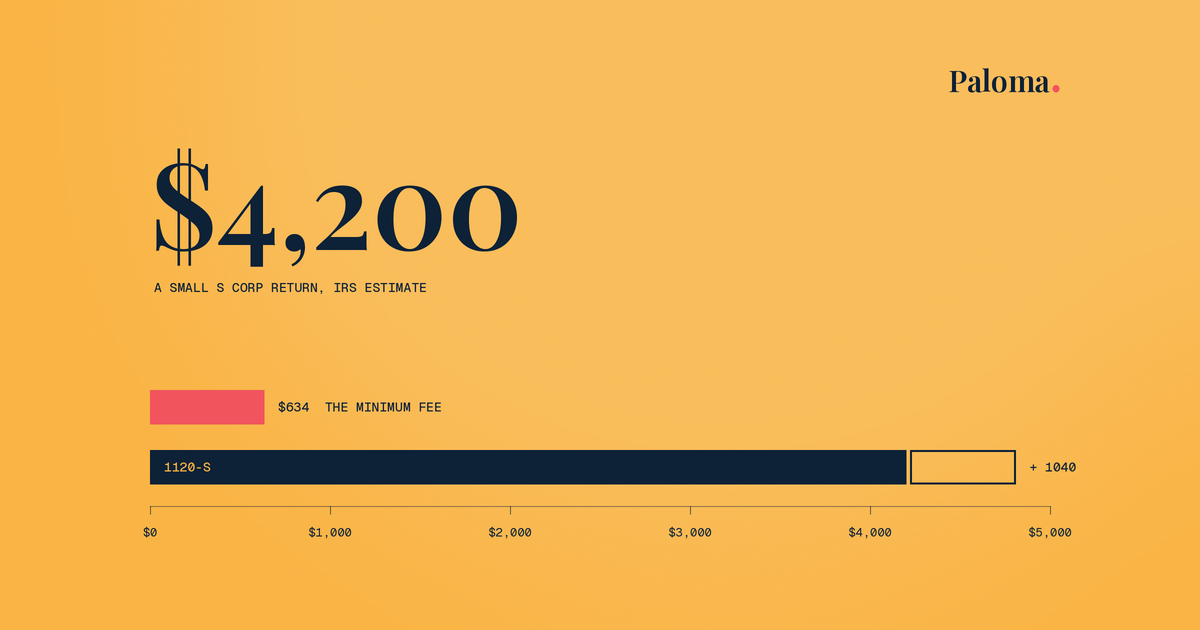
How Much Does It Cost to Have Business Taxes Done?
What business tax returns really cost once you add the owner's return, states and books, plus how to get a fixed quote before tax season.
Read more →Want someone to handle your taxes?
Paloma prepares returns for freelancers, small businesses and individuals, with a fixed quote within 24 hours.
Get your quoteReferences
- IRS: Topic 254, How to choose a tax return preparer
- IRS: Tips for choosing a tax professional
- IRS: Understanding tax return preparer credentials and qualifications
- IRS: Publication 509 (2027) draft tax calendar
- IRS: Topic 311, Power of attorney and tax information authorization
- IRS: What kind of records should I keep
- Accounting Today: What do tax preparers charge (NATP 2025 fee study)