Jump to section
Tax Preparer for Freelancers: What to Look For and Send
What a good tax preparer for freelancers does beyond April: quarterly estimates, self employment tax, 1099s and the records to send for 2027.
·8 min read·Updated November 19, 2026·By Abby Melby
Key Takeaways
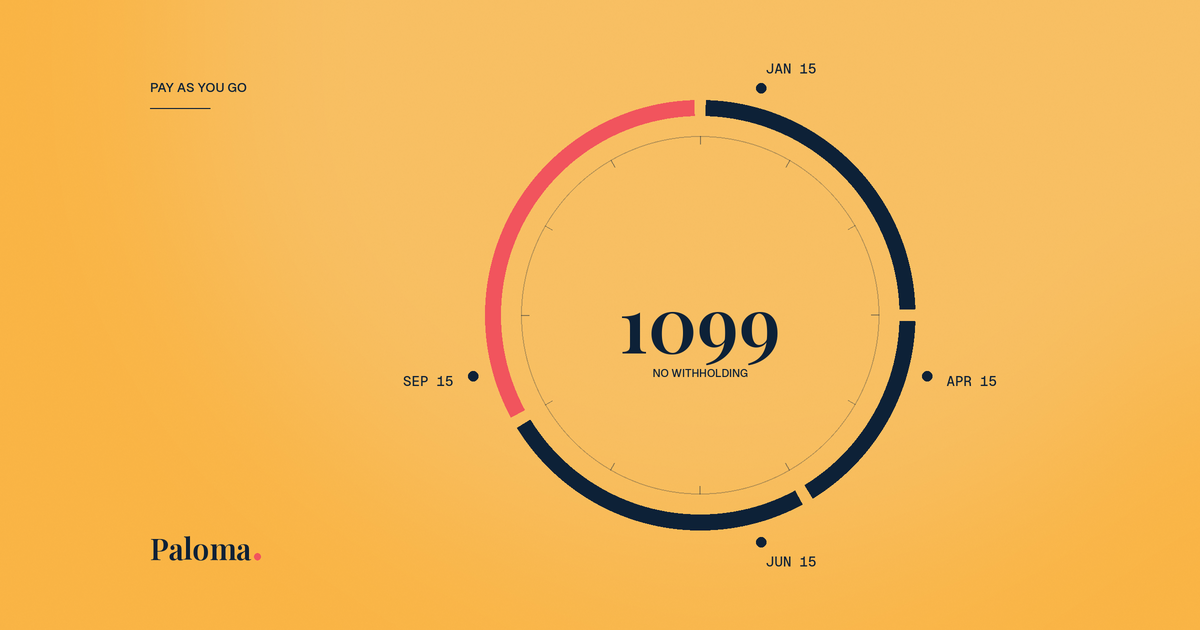
- Nobody withholds tax from freelance income, so the IRS expects you to pay during the year through quarterly estimated payments.
- Self employment tax is 15.3% on top of income tax, and it applies once your net earnings reach $400.
- You have to report all of your income, even payments that never show up on a 1099.
- Pick a preparer who works with you all year, not just someone who files once in April.
A good tax preparer for freelancers does more than file your Schedule C in April. They help you set quarterly estimated payments, figure your self employment tax, match every 1099 to your own records, and tell you what to send before the first deadline so you aren't surprised by a bill.
If you want the general rules for hiring any preparer (credentials, IRS red flags, what you'll sign), we covered those in hiring someone to do your business taxes. This post is about what's different when the person hiring is a freelancer.
Why freelancer taxes are different
When you had a W-2 job, your employer took tax out of every paycheck and sent it to the IRS for you. As a freelancer, nobody does that. The IRS says that if you're self employed, you're generally required to file an annual return and pay estimated taxes quarterly (IRS).
That one change creates most of the work:
- You owe two taxes, not one. Income tax plus self employment tax, which is your Social Security and Medicare.
- You pay during the year. Four estimated payments, on dates that don't line up with the calendar quarters.
- Your income is scattered. Some clients send a 1099, some don't, and payment apps report on their own rules.
- Your deductions are on you. Nobody hands you a form listing your business expenses. They come from your own records.
A preparer who works with freelancers should be comfortable with all four, especially the second and third.
Self employment tax, in plain English
The IRS sets the self employment tax rate at 15.3%, made up of a Social Security part and a Medicare part (IRS). An employee splits that cost with their employer. As a freelancer you pay both halves.
You owe it and file Schedule SE once your net earnings from self employment are $400 or more. Net earnings means your income minus your business expenses, which is why good records lower more than just your income tax. The IRS also lets you deduct the employer equivalent portion of your self employment tax when figuring your adjusted gross income.
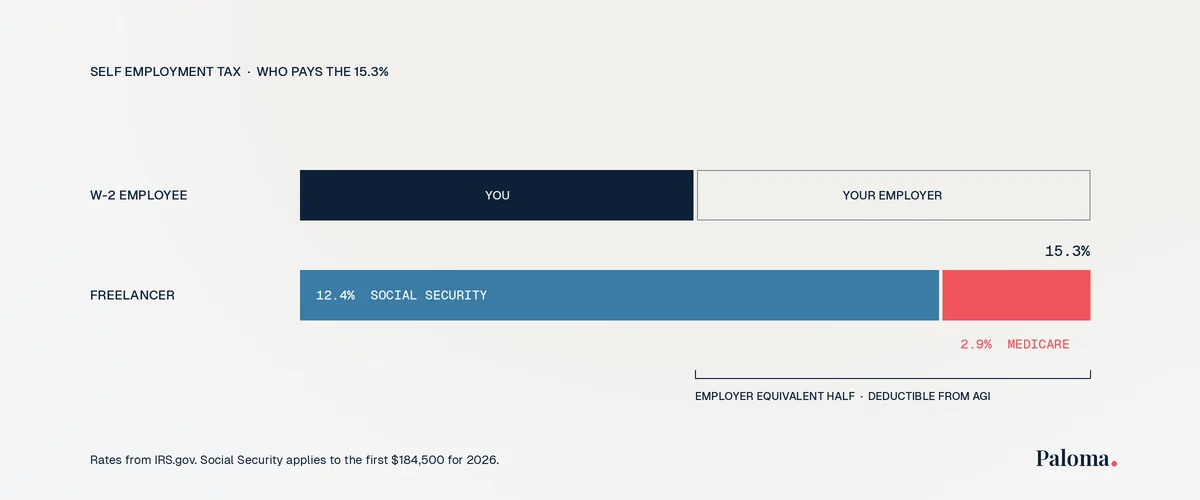
For 2026, the Social Security part only applies to the first $184,500 of your combined wages, tips and net earnings. The Medicare part has no cap. If you also have a W-2 job, your preparer needs those wages too, because they count toward that limit.
Get your tax prep quote
A fixed quote within 24 hours, signed off by a licensed tax pro
Quarterly estimated taxes
The IRS says individuals, including sole proprietors, generally need to make estimated payments if they expect to owe $1,000 or more when they file (IRS). You use Form 1040-ES to figure them, and you can pay online, by phone or through your IRS online account.
Here's the part that trips people up. The payments are called quarterly, but the periods they cover aren't equal (IRS). For the year ahead, the dates from the IRS's draft 2027 tax calendar are:
- January 15, 2027: last payment for tax year 2026
- April 15, 2027: first payment for 2027
- June 15, 2027: second payment
- September 15, 2027: third payment
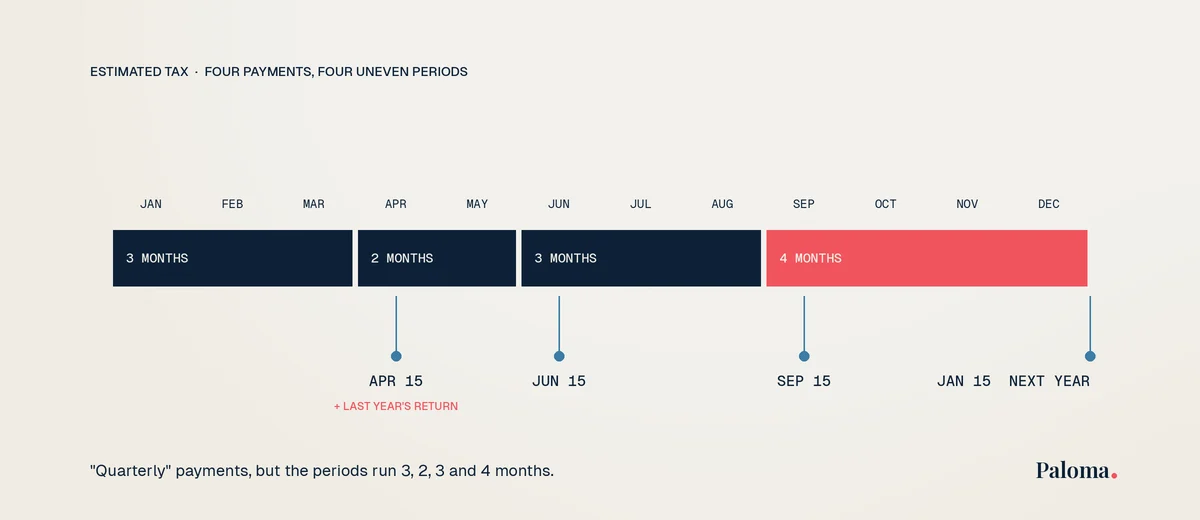
Notice that April 15 is also the day your 2026 return and any balance are due. That's two payments on the same day, and it's the one freelancers forget to save for.
If you pay too little or pay late, you can owe a penalty even if you end up getting a refund. The IRS says most people avoid it if they owe less than $1,000 after withholding and credits, or if they paid at least 90% of this year's tax or 100% of last year's, whichever is smaller. There are special rules for higher income taxpayers, so ask your preparer which target applies to you.
If your income comes in unevenly (a big project in the fall, a slow spring), the IRS lets you annualize your income and make unequal payments using Form 2210. That's exactly the kind of thing a freelancer focused preparer should bring up without you asking.
1099s and income you have to report
Clients who paid you for your work may send you a Form 1099-NEC. For 2026 payments, those are due to you by February 1, 2027 (IRS draft calendar).
Payment apps and online marketplaces are different. The IRS says they have to send a Form 1099-K when your payments for goods or services top $20,000 in more than 200 transactions, though they may send one for less (IRS). If clients pay you directly by card, your card processor sends one no matter the amount.
The rule that matters most: whether or not you get a 1099, you still have to report all of your income. A client who forgot to send a form doesn't make that money tax free. So your preparer should start from your own invoices and deposits, then use the 1099s to check them, not the other way around.
Watch for the same payment showing up twice, too. A client who pays you through a payment app might also send you a 1099-NEC for the same work. Your preparer should match each form to your records so you only pay tax on it once.
Expenses a freelancer preparer should ask about
Your business income goes on Schedule C, and so do your business expenses (IRS). A good preparer will walk through the common ones with you instead of waiting for you to bring them up:
- Home office, if you use part of your home for the business. The IRS says renters can take it too.
- Vehicle mileage for business driving, with a log.
- Software, equipment and supplies you bought for the work.
- Phone and internet, for the business share.
- Health insurance you pay for yourself, which has its own self employed deduction.
- Fees from payment apps and freelance platforms, which are easy to miss when you only look at the deposit.
Paloma's online tax preparation for small businesses includes Schedule C for one sole proprietor business, with home office, vehicle mileage, depreciation and the qualified business income deduction.
Start your return
Answer a short form about your year and upload documents from your phone
What to send your preparer
Here's a checklist for a freelancer's 2026 return. You won't have every item, and that's fine.
- Every 1099-NEC and 1099-K you received
- Your own income records: invoices, payment app reports and business bank deposits
- Business bank and credit card statements for the year
- Receipts for bigger purchases, like a laptop or equipment, with the date you bought them
- Your mileage log
- Your home office square footage and your home's total square footage, if you use one
- Health insurance premiums you paid yourself
- The date and amount of every 2026 estimated payment you made
- Any W-2 if you also had a job
- Last year's return
The estimated payments line matters more than it looks. If your preparer doesn't know what you already paid, your return will show a bigger balance than you really owe.
Send all of it through a secure upload, never by email. Your return has your Social Security number and bank details in one place.
What to look for in a tax preparer for freelancers
The basics of picking any preparer still apply. On top of those, these are the things that matter most for freelancers:
They set your estimates for next year. The return is half the job. The other half is telling you what to pay on April 15, June 15, September 15 and January 15 so next year doesn't start with a surprise.
They're around after April. Freelance income changes. If you land a big client in July, you want someone who can update your estimate, not an office that's closed until January.
They know when your setup should change. Some freelancers outgrow a plain sole proprietorship. If you're wondering about an LLC or an S corp, our guide on whether you need a CPA for your LLC walks through how each one is taxed.
They can help with messy books. If your income and expenses live in three apps and a shoebox, ask whether they work with a bookkeeper who can clean things up first.
They quote up front. Ask for a fixed price before they start, based on what you actually have. We broke down what drives the price in how much it costs to have business taxes done.
If you're filing on your own this year, here's how to file taxes for a single member LLC, form by form.
Frequently Asked Questions
Do freelancers need a tax preparer?
No law says you have to use one. Plenty of freelancers file their own Schedule C. A preparer earns their fee when your income is uneven, you have several 1099s, you're behind on estimated payments, or you'd rather spend tax season working.
Do I have to pay quarterly taxes as a freelancer?
Usually. The IRS says you generally need to make estimated payments if you expect to owe $1,000 or more when you file. You can skip them if you had no tax liability last year, were a U.S. citizen or resident all year, and last year covered a full 12 months.
What if I didn't get a 1099 from a client?
You still report the income. The IRS says you have to report all income from goods or services whether or not you get a form. Use your invoices and deposits.
What's the minimum income to file taxes as a freelancer?
If your net earnings from self employment were $400 or more, you need to file and pay self employment tax. You may need to file below that if you meet another filing requirement.
Can my preparer figure my estimated payments for next year?
A good one will. Ask before you hire. Our firm includes next year's estimated payment amounts with the return if you need them.
Can a freelancer get an extension to file?
Yes. Form 4868 gives you an automatic 6 month extension to file, but not to pay. Pay what you expect to owe by April 15 to avoid penalties (IRS).
What's the best way to send documents to a tax preparer?
A secure portal with upload and e-signature. Avoid email for anything with your Social Security number or bank details.
Get help with your freelance taxes
At Paloma, we prepare returns for freelancers, small businesses and individuals. You get a fixed quote within 24 hours, every return is reviewed and signed off by a licensed tax professional, and your federal return and one state return are included. If you want a hand this season, see our online tax preparation for small businesses, browse more tax guides, or book a free call with me and we'll see if we're a good fit.
Get help with your taxes
Related Articles
LLC vs S Corp Taxes: How the Math Works and When to Switch
An LLC is a legal entity and an S corp is a tax election. See how each is taxed, a side by side example, and when electing S corp status pays off.
Read more →
LLC vs S Corp Taxes: How the Math Works and When to Switch
An LLC is a legal entity and an S corp is a tax election. See how each is taxed, a side by side example, and when electing S corp status pays off.
Read more →
How to File Taxes for a Single Member LLC: A Simple Checklist
A plain guide to filing taxes for a single member LLC: Schedule C, Schedule SE, payroll forms, state fees, deadlines and the mistakes to skip.
Read more →
Bookkeeping and Tax Services for Small Business: How They Fit
What a bookkeeper does, what your tax preparer does, the records the IRS expects you to keep, and how to set up both before the 2027 season.
Read more →Want someone to handle your taxes?
Paloma prepares returns for freelancers, small businesses and individuals, with a fixed quote within 24 hours.
Get your quote