Jump to section
LLC vs S Corp Taxes: How the Math Works and When to Switch
An LLC is a legal entity and an S corp is a tax election. See how each is taxed, a side by side example, and when electing S corp status pays off.
·9 min read·By Abby Melby
Key Takeaways
- An LLC is a legal structure from your state. An S corp is a tax election you make with the IRS. Your LLC can be both.
- A default single member LLC pays self employment tax of 15.3% on 92.35% of its net profit (the Social Security part stops at the wage base).
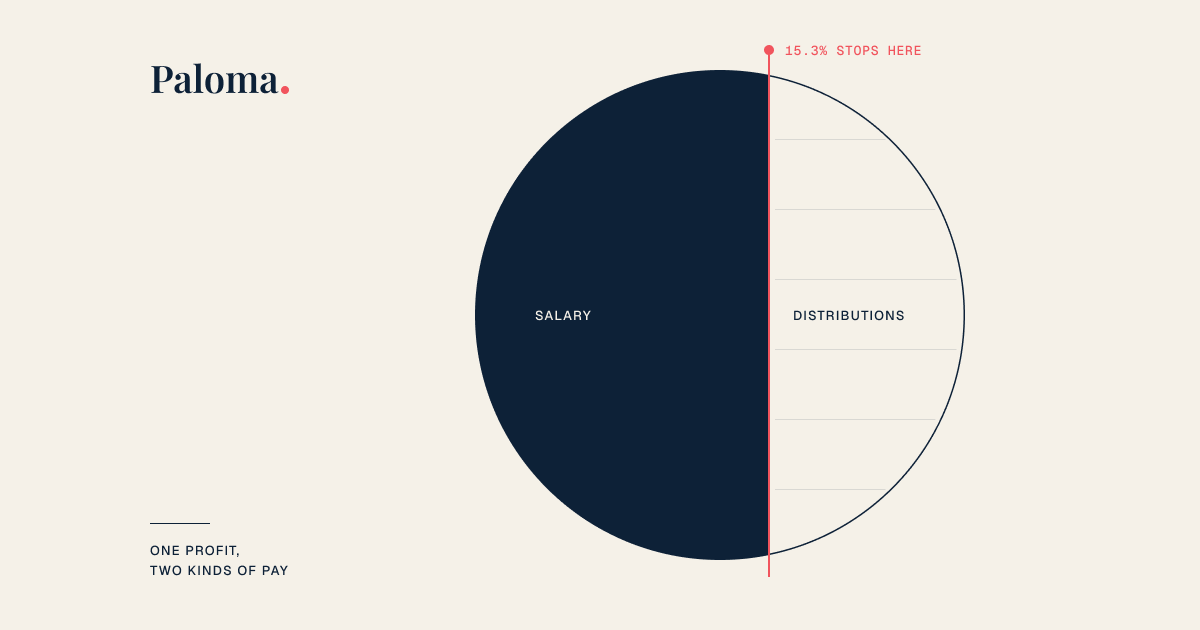
- As an S corp, you pay yourself a reasonable salary through payroll, and only that salary gets hit with Social Security and Medicare taxes.
- The election adds a business return, payroll and K-1s every year, so it usually only pays off when profit is steady and well above a fair salary for your work.
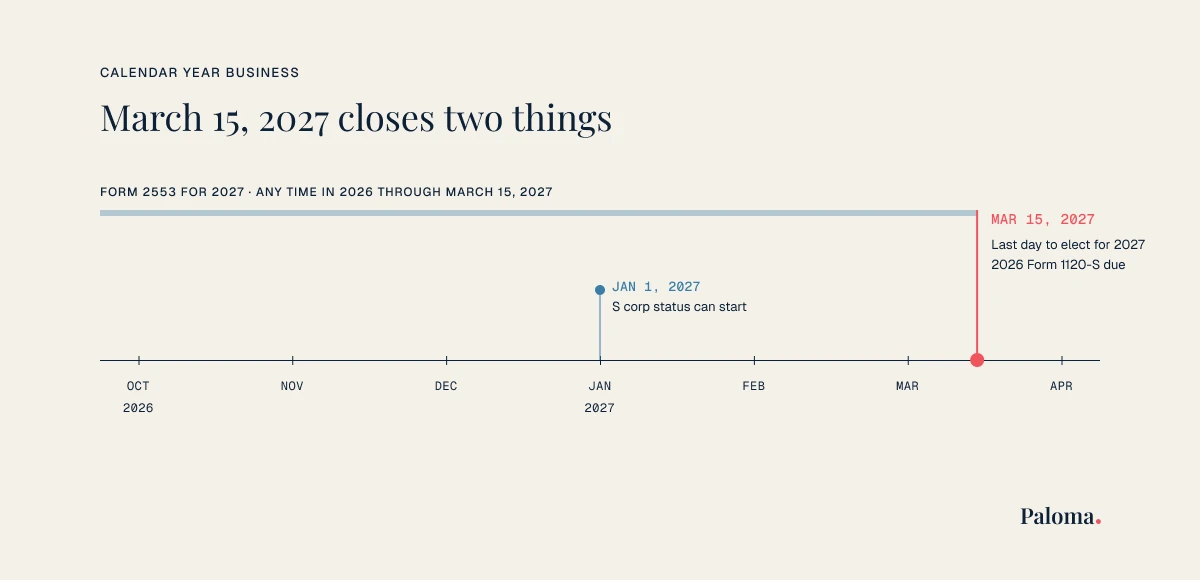
- To be an S corp for 2027, file Form 2553 by March 15, 2027. Late election relief exists if you miss it.
The big tax difference between an LLC and an S corp is self employment tax. A default LLC owner pays 15.3% on most of their profit, while an LLC taxed as an S corp pays that rate only on a reasonable salary run through payroll. The savings are real once profit is steady, but so is the extra paperwork.
LLC vs S corp: one is an entity, one is a tax election
This is the part that confuses almost everyone, so let's get it out of the way. An LLC is something you form with your state. It gives you a legal wrapper around the business. An S corp isn't something you form at all. It's a way of being taxed that you choose by filing Form 2553 with the IRS.
So the real comparison is "my LLC taxed the default way" vs "my LLC taxed as an S corp." You keep the same LLC either way.
By default, the IRS treats a single member LLC as disregarded from its owner and a multi member LLC as a partnership. We walked through each of those setups, and when each one needs help, in our guide on whether you need a CPA for your LLC. This post sticks to the money question: what changes on your tax bill if you elect S corp status.
If you'd rather have someone run your real numbers, our online tax preparation for small businesses starts with a fixed quote within 24 hours, and we prepare both Schedule C returns and 1120-S returns.
How a default LLC is taxed
With no election, your LLC's profit lands on your personal return. For a single member LLC that's usually Schedule C. You pay regular income tax on the profit, plus self employment tax.
Here's how the IRS figures self employment tax:
- The rate is 15.3%. That's 12.4% for Social Security and 2.9% for Medicare (IRS).
- It applies to 92.35% of your net earnings. The IRS says that's "generally" the amount subject to self employment tax (IRS Topic 554).
- Social Security stops at the wage base. For 2026, only the first $184,500 of combined wages and self employment earnings is subject to the 12.4% part (IRS). Medicare has no cap.
- You get half of it back as a deduction. You can deduct the employer equivalent portion of self employment tax when figuring your adjusted gross income (IRS Topic 554). That lowers income tax, not the self employment tax itself.
- It kicks in at $400. You generally owe it once net earnings from self employment are $400 or more (IRS).
The key thing to notice: in a default LLC, almost every dollar of profit is treated like pay for your work, whether you take it out of the business or not.
Get your tax prep quote
A fixed quote within 24 hours, signed off by a licensed tax pro
What changes when your LLC is taxed as an S corp
An S corp is a corporation that elects to pass its income, losses, deductions and credits through to its shareholders (IRS). You still pay income tax on the profit on your personal return. What changes is how your pay is split.
Part one: a reasonable salary through payroll
If you work in the business, the IRS says S corporations "must pay reasonable compensation to a shareholder employee" (IRS). That salary goes through real payroll. The business withholds 6.2% Social Security and 1.45% Medicare from your check and pays a matching 6.2% and 1.45% itself, so 15.3% in total (IRS Topic 751).
Part two: distributions
Whatever profit is left after your salary and other expenses can come out as distributions. The IRS notes that non wage distributions aren't subject to employment taxes (IRS). That gap is the whole tax case for an S corp.
The catch: "reasonable" is not a number you pick to save tax
The IRS can reclassify distributions as wages if the money really came from your own work. When the business earns its money from your personal services, the IRS says those payments should be treated as wages. The IRS lists factors like your training and experience, your duties, the time and effort you put in, and what comparable businesses pay for similar services (IRS). A salary that looks low next to the work you actually do is exactly what invites that question.
A side by side example (hypothetical)
Let's run one simple, hypothetical case. A single owner LLC has $100,000 of net profit for 2026, and the owner works in it full time. This only compares Social Security and Medicare taxes, using the IRS rates above. It leaves out income tax, state tax, unemployment tax and the cost of payroll and an extra return.
| Default LLC | S corp, $80,000 salary | S corp, $60,000 salary | |
|---|---|---|---|
| Amount taxed for Social Security and Medicare | $92,350 (92.35% of $100,000) | $80,000 salary | $60,000 salary |
| Rate | 15.3% | 15.3% (7.65% you + 7.65% business) | 15.3% (7.65% you + 7.65% business) |
| Social Security and Medicare tax | $14,130 | $12,240 | $9,180 |
| Difference vs default LLC | $1,890 less | $4,950 less |
A few things jump out.
The salary drives everything. At a $60,000 salary, the gap is about $4,950. At $80,000, it shrinks to $1,890. And a salary close to the full profit erases most of the difference.
You can't just pick the low number. Whether $60,000 or $80,000 is reasonable depends on what someone doing your job would earn. That's a real question to answer before you set up payroll, not a dial to turn down.
Costs come off the top. Payroll service, a separate 1120-S return and state filings all cost money. If the savings in your version of this table are smaller than those costs, the election isn't helping you yet. Our breakdown of how much it costs to have business taxes done can help you put a rough number on that side.
One more detail: the 12.4% Social Security part only applies up to $184,500 for 2026, and an extra 0.9% Medicare tax applies above $200,000 of wages or self employment income for single filers (IRS). So the math looks different at higher incomes, which is one more reason to run your own numbers.
What the election adds every year
Electing S corp status isn't a one time form. It changes your tax year from one personal return to a small stack of filings:
- Form 1120-S for the business, due the 15th day of the 3rd month after year end (IRS). For a calendar year S corp, the 2026 return is due March 15, 2027.
- A Schedule K-1 for each shareholder.
- Payroll filings during the year, including Forms 941 and 940 and a W-2 for you.
- Your own Form 1040, which waits on the K-1.
Miss the 1120-S deadline and the penalty is $255 per shareholder for each month or part of a month it's late, up to 12 months, even with no tax due. That's the figure in the 2025 Form 1120-S instructions, the latest ones out right now, so check the 2026 instructions for the amount that applies to returns due in 2027. We cover the full document list and filing order in our guide to S corp tax preparation, so I won't repeat it here.
Start your return
Answer a short form about your year and upload documents from your phone
When switching tends to make sense, and when it doesn't
There's no single profit number that makes an S corp the right call. Here's how I'd think about it.
| Your situation | Default LLC | S corp election |
|---|---|---|
| New business, profit still unpredictable | Usually the better fit | Often too early |
| Profit is small, or about what a fair salary for your work would be | Usually the better fit | Little to save after costs |
| Profit is steady and well above a reasonable salary for your role | Costs more in self employment tax | Worth running the numbers |
| You already have, or want, clean monthly books and payroll | Either works | Easier to keep compliant |
| You hate admin and file once a year | Usually the better fit | Payroll and a second return every year |
| You have a partner who isn't an individual, or want investors with different share classes | Default can work | S corps allow only eligible shareholders and one class of stock |
That last row matters. The IRS says an S corp must be a domestic corporation with no more than 100 shareholders, only allowable shareholders (individuals, certain trusts and estates) and only one class of stock. Partnerships, corporations and nonresident aliens can't be shareholders (IRS).
Signs it's worth a closer look:
- Your profit has been steady for at least a full year
- You're paying a lot more in self employment tax than you expected
- Your books are already reconciled every month, or you're ready to get them there
- You're comfortable running payroll for yourself on a regular schedule
How and when to elect S corp status
The form
You make the election with Form 2553, signed by every shareholder. An LLC that files a timely Form 2553 and meets the tests is treated as a corporation as of the election's effective date, and the IRS instructions say it doesn't need to file Form 8832 too (IRS).
The deadline
Form 2553 has to be filed either:
- no more than 2 months and 15 days after the beginning of the tax year the election is to take effect, or
- at any time during the tax year before it takes effect.
For a calendar year LLC that wants to be an S corp starting January 1, 2027, that window runs through March 15, 2027. Filing in late 2026 works too. You should generally hear back within 60 days (IRS).
If you missed it
The IRS offers late election relief when there was reasonable cause for filing late and Form 2553 is filed within 3 years and 75 days of the date the election was meant to take effect (IRS). The form gets marked "FILED PURSUANT TO REV. PROC. 2013-30" at the top. If you think you've been operating like an S corp without a valid election, that's a good time to get help rather than guess.
Frequently Asked Questions
Is an LLC or an S corp better for taxes?
It depends on your profit and your salary. A default LLC pays self employment tax on most of its profit. An S corp pays employment taxes only on a reasonable salary, but adds payroll and a separate return. Steady, higher profit tends to favor the S corp.
Can my LLC be taxed as an S corp?
Yes. An eligible LLC files Form 2553 and, once the election takes effect, is treated as a corporation that has elected S status. You keep your LLC with the state.
How much salary do I have to pay myself as an S corp?
There's no set number. The IRS requires reasonable compensation for the work you do, and it looks at factors like your duties, time, experience and what comparable businesses pay for similar services.
When is the deadline to elect S corp status for 2027?
For a calendar year business, file Form 2553 by March 15, 2027, which is 2 months and 15 days after January 1. You can also file any time during 2026 for a January 1, 2027 start.
What if I missed the Form 2553 deadline?
You may qualify for late election relief if you had reasonable cause and file within 3 years and 75 days of the intended effective date, using Rev. Proc. 2013-30.
Do I still pay self employment tax as an S corp?
Not on your S corp income. Instead, your salary has Social Security and Medicare withheld through payroll, and the business pays a matching share. Distributions aren't subject to employment taxes.
Does an S corp election change my state taxes?
It can. States have their own rules and filings for S corps, so check yours before you elect.
Want someone to run your numbers?
If you're weighing the switch, the fastest way to know is to put your real profit and a reasonable salary side by side. Send us your documents through our online tax preparation for small businesses and you'll get a fixed quote within 24 hours, with every return reviewed and signed off by a licensed tax professional. You can also grab a time to chat or browse more of our small business tax guides.
Get help with your taxes
Related Articles
LLC vs S Corp Taxes: How the Math Works and When to Switch
An LLC is a legal entity and an S corp is a tax election. See how each is taxed, a side by side example, and when electing S corp status pays off.
Read more →
How to File Taxes for a Single Member LLC: A Simple Checklist
A plain guide to filing taxes for a single member LLC: Schedule C, Schedule SE, payroll forms, state fees, deadlines and the mistakes to skip.
Read more →
Bookkeeping and Tax Services for Small Business: How They Fit
What a bookkeeper does, what your tax preparer does, the records the IRS expects you to keep, and how to set up both before the 2027 season.
Read more →
Tax Preparer for Freelancers: What to Look For and Send
What a good tax preparer for freelancers does beyond April: quarterly estimates, self employment tax, 1099s and the records to send for 2027.
Read more →Want someone to handle your taxes?
Paloma prepares returns for freelancers, small businesses and individuals, with a fixed quote within 24 hours.
Get your quoteReferences
- IRS: Self employment tax (Social Security and Medicare taxes)
- IRS: Topic 554, Self employment tax
- IRS: Topic 751, Social Security and Medicare withholding rates
- IRS: Instructions for Schedule SE
- IRS: S corporations
- IRS: S corporation compensation and medical insurance issues
- IRS: Limited liability company (LLC)
- IRS: Instructions for Form 2553
- IRS: Instructions for Form 1120-S